The role of women in the agriculture sector cannot be under estimated in the African continent considering that they are responsible in putting food on the table in their families.
Experts contend that Ugandan women farmers
provide up to 90% of the labor for food production by growing resilient staple
crops with cassava being the core.
Since the United Nations has dedicated the
year 2026 to women farmers across the globe being major contributors to food security,
Seeds of Gold reached out to selected women farmer groups in Luwero district to
highlight their success stories.
One such a group are women farmers located
in Zirobwe who have over the last 12 years dedicated themselves in growing
cassava as food security crop, nutrition and income earning initiative.
Background
Scientists from the National Agricultural
Research Organisation (NARO) have collaborated with local communities and
women's groups on participatory cassava research since the 1990s.
This is a result of a major efforts by
scientists from the National Agricultural Resources Research Institute (NaCRRI)
to restore cassava production after severe Cassava Mosaic Virus (CMV) and
Cassava Brown Streak Virus (CBSV) epidemics.
Formalized grassroots multi stakeholder
platforms and specific gender focused projects have continued to expand through
initiatives launched across various regions in recent years including localized
gender responsive and value chain programs in 2022 - 2025.
Women groups growing cassava in Zirobwe
have been empowered by turning a traditional subsistence crop into a
profitable, market driven business through cooperatives and improved farming
methods
Statistics about women farmers
Women farmers are celebrated every minute
but the United Nations decided to dedicate the year 2026 specifically to
celebrate the woman farmer.
Organisations such as the Consortium of International Agricultural
Research Centres (CGIAR) has been at the core of the initiative.
One of the
consortiums Alliance Bioversity and CIAT in its recent publication “What does
it mean to be a woman farmer in 2026” authored by their communication
specialists Anastacia Wanjiru and José Luis
Urrea-Benítez states that women produce 60% - 80% of the world’s food.
Globally the women make up 40% of the
agricultural workfoce heighlights opportunities to reduce gender inequality
through a set of targeted solutions from isntitutional, legal and social
reforns to includive infrastructure, social protection, improved data gathering
and responsible use of emerging techologies.
The authors went ahead to quote Natalia
Triana a researcher in Gender and Social inclusion at Alliance Bioversity and
CIAT saying “the real question is not how much food do women produce but how
much control do they have over the resources, income and decision linked to
that production,”
In the latest report, released by the
CGIAR GENDER Accelerator about how actors can close gender gaps in agricultural
production by the year 2050, the publishers note that this can be done through
food system transformation.
"The choice we make over the coming
years will determine whether food, land and water systems become more equitable
or more unequal, resiliant or fragile. We cannot feed our future generation
without including women in our food systems," said Ismahane Elouaf,
Executive Managing director of CGIAR.
"This report moves to beyond
recommending pieceneal interventions to outlining systemic structural changes
that can decievely close the gender gap across food systems by 2050," she
adds.
In Uganda, the records by Uganda Bureau of Statistics indicate
that women account for roughly 70% to 90% of basic food production and on farm
labour.
The participation rate indicates that 76%
of employed women in Uganda work in farming, compared to 62% of employed men.
The data further states that about 3.9
million women work across 7 million agricultural households and women make up
over 50% of the total agricultural workforce.
The executive director Food Rights
Alliance Ms Agnes Kirabo adds that women across the globe play a critical role
in agrii-food business and the need to be celebrated.
To her the issue is no longer women not
owning land for agricultural production because a good number of women now have
capacity to purchase land for farming.
She backed this by policies which are
supportive of Ugandan women farmers namely the Agriculture Sector Strategic
Plan which prioritises gender mainstreaming to ensure agricultural planning,
budgeting and extension service delivery.
Other are the National Land Policy 2013
which protects women and children on land rights and Uganda National Social
Protection Policy which seeks to reduce rural vulnerability and supporting
women farmers through targeted financial inclusion.
Internationally women farmers are covered
under the 1995 Beijing declaration and platform global blueprint for gender
equality which specifically addresses women in Agriculture by calling for equal
access to land and economic resources.
How cassava farming empowers women in
Zirobwe and how it all started
The director in charge of root crops at
NaCRRI Dr Bernard Yada explains that in 2015 his team released Narocas I
cassava variety which is drought tolerant, resistant to CMV and CBSV.
They embarked in promoting it in
communities to intensify cassava production.
The scientists later trained and
sensitized the women group in Zirobwe in best agronomy practices and availed
them with clean planting materials.
These farmers were sensitized on how to
grow cassava for food and for commercialisation where they sell both the roots
and the stems.
The production intensified in the year
2022 to date a number of farmers are growing the variety both on small and
large scale.
Scientists encouraged the women to grow
both Naroscas I and Nase14 varieties because both have different attributes
especially when boiled Nase14 variety is softer than NaroscasI.
However NarocasI gives better yield than
Nase14 and the tubers are heavy which is good for commercialisation.
Women in Uganda are more involved in
growing cassava than men because it is considered to be climate resilient to
provide food during shortage.
Looking at specific local research studies
referencing UBOS gender data regarding cassava, separate academic survey
indicates that women comprise a dominant part of the labor force for root
crops, with up to 68% of women
participating directly in cassava-specific farm activities.
Dr
Yada explains that there is challenge of increased production
rate since women grow cassava on less fertile soil.
Scientists work directly with local
women’s groups to clean up virus strains and set up local seed multiplication gardens.
This approach ensures women have a steady
supply of certified, virus free planting materials right in Zirobwe,
transforming them from simple growers into premium seed seller.
The women have also been sensitized in
post-harvest value addition where they are encouraged to dry cassava on raised
solar dries to obtain quality flour. This opens doors to lucrative markets,
including bakeries and breweries.
The scientists have introduced gender
responsive tools, such as motorized cassava chippers and graters, which sharply
cut down processing times.
Dr Yada explained that women use
traditional knowledge and intercropping techniques where they plant cassava
alongside other crops varieties as protective measure against unpredictable
weather.
Success stories
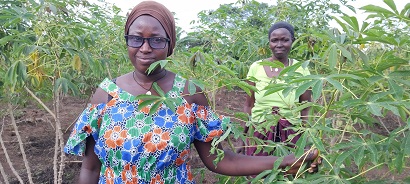
Ms Rose Ajune is a maize
and cassava farmer in
Kireeba village, Zirobwe sub-County,
Bamunanika County in Luwero District.
She explains that previously women farmer groups
belonged to Zirobwe Agaliwamu Agribusiness Training Association (ZAABTA),
but most farmer groups have since split and formed their associations according
to the crop varieties they farm.
ZAABTA members are mostly farmers growing maize in
large-scale, and since Ajune is involved in growing
maize, she still belongs to the group.
However she is now actively involved in leading the
women growing cassava and their association called Tukolere Wamu farmers
Association comprising of 34 members.
Ajune farms
on 12 acres of family land, which is owned by
her husband. She grows cassava on 2 acres and maize on the
rest.
She got interested in cassava farming after scientists from NaCRRI sensitised her, and her team, about the benefits of growing cassava as food security
crop.
This was in 2012, when
the district agricultural officer Franco Ejakait led the scientists to Zirobwe
farming communities.
They were sensitised
on how to manage the whitefly, which spreads cassava virus by dipping the
stems in a recommended chemical before planting.
A good number of farmers adopted the idea,
but have since abandoned it to women, who
now grow cassava on more than 20 acres.
Ajune
says that cassava is not considered a food crop in central Uganda,
but since it is climate resilient, many farmers are beginning to grow it.
The group has a communal cassava farm
comprising of one and a half acres and so far they have conducted the first
harvest where they sold tubers worth USh1.2
million.
The group has a village savings scheme and
have
since bought plastic chairs,
which are hired out to people at a fee.
Their next target is to purchase tents
because make tem earn better.
They usually bulk their harvest in order
to attract better price but they also sell individually. A suck of 100kg fresh
tubers is sold at Sh90, 000 depending on the
variety and yield.
Ajune,
aged 39, began farming while still a primary school teacher, before her sight deteriorated two years
ago,
forcing her to quit teaching. She is now a full-time farmer. She says she harvests at least 7
tonnes of cassava every season.
Farming has paid her family off since she
is able to care for their welfare including paying school fees for her two
children and about 8 dependants.
Ms Florence Najjuko grew up farming
assorted crop varieties with her parents. She carried this career into her marriage life.
She grows cassava on some 2.5
acres and
sells part of the harvest as fresh and processes
quality flour from the remainder. She sells the cassava in both forms
at her shop and does not hire labourers.