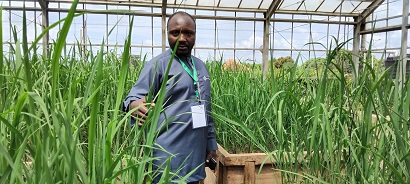
Agricultural scientists responsible for breeding Rice varieties are deploying climate smart and market driven technologies to bridge Uganda’s rice deficit and boost production.
This is
being done in collaboration with experts from Africa Rice Centre under a
programme Technologies for Africa Agricultural Transformation (TAAT).
This was
revealed in a recent business to business dialogue involving rice breeders,
seed companies, farmers and all those involved in the rice value chain to
address ways of how to increase Ugandan bred rice varieties for consumer
uptake.
Background
According to the head of Cereals program at the National Crops Resources
Research Institute (NaCRRI) Dr Jimmy Lamo, rice is the country’s second most
important cereal after maize and consumption is rising with population growth
and urbanization.
According to the figures from the Ministry of Agriculture, Uganda still
imports about a third of the rice it eats. Its mills, meanwhile run at roughly
59% of installed capacity, largely because farmers and millers have no
contractual link.
Dr Lamo notes that Rice was introduced in the country in 1900 with
farmers adopting the irrigated K- series.
However from the year 2004 developmental partners particularly the Japan
government came in to support breeding programs to date.
Through the
National Research Organization (Naro) and Japan International Cooperation
Agency (JICA), Nerica varieties were developed and released.
Later
through Korean government initiatives lowland varieties namely NARO Rice 1- 5 and Wita 9 and highland varieties
Okile and NamChe were released for farmer uptake.
In the entire Africa about 75 rice
varieties have so been released which has led to increased acreage wit 40%
increase in production.
What the TAAT program is doing to
increase rice production
The
Coordinator of the TAAT compact program at the Africa Rice Centre Dr Erasmus Nchuaji Tang noted that “to increase
rice production in Uganda, it requires both public and private partnership
engagement,”
This will be
done through Technology adoption which
include introduction of climate smart varieties which are high yielding and
designed to withstand climate shock conditions.
Others are improved Seed System to strengthen
seed multiplication and distribution networks through public-private
partnerships with local seed companies.
Scaling
labor saving and precision tools, such as good quality threshers, efficient
land preparation equipment and straight line planting techniques to reduce seed
rates and boost efficiency.
Post-Harvest and processing technologies through upgrading value addition by farmers
adopting improved drying systems, hermetic storage solutions and better
industrial milling coordination to raise head rice recovery and reduce
post-harvest losses.
Digital advisory and profiling tools to utilize
digital platforms such as eProd, Rice Advice and SMS advisory systems for
farmer registration, field mapping, traceability, weather updates and input
access.
Fostering
direct contractual links and out-grower agreements between smallholder farmers,
millers and financiers to ensure local mills operate closer to full capacity
instead of sitting idle while grain is imported.
He said “the TAAT program is targeting about 160
participants, at least 60 one-to-one business meetings and 25 recorded
commitments and at least five off-take or out-grower agreements. The initiative
supports Uganda’s National Rice Development Strategy II 2020-2030, which aims
to raise paddy production from about 247,000 tons in 2022 to 663,000 tons by
2030,”
According to Dr Tang so far TAAT rice delivery initiative
has achieved 67,739 tons of climate resilient rice seed, with 2.35 million
acres planted across Africa and 2.25 million farmers benefiting.
About 791 million US dollars has been invested in 8
countries including Uganda with 32% households benefiting across Africa.
Already the program modal is working in a number of countries
in West Africa with farmers adopting solar powered irrigation systems and
integrated Rice fish farms in order to harvest double. This he says must be
adopted in Uganda.
The Program coordinator in Uganda Dr Arthur Wasukira
explained that TAAT started in 2018 with the initial program supporting rice
variety development and his team bread and released Nam che4 (ARICA) rice
variety out of this initiative.
“Along the way we reviewed the seed roadmap to meet national
rice development targets where we conducted expert training with personnel in
seed companies to produce quality seed. This led to 1,400 tons of rice seed
production by Equator seed and farmer cooperatives in Doho Irrigation Scheme,
Kweba Holding in Butaleja, Mubuku Famers Cooperatives in Kasese and Adagani
farmer Cooperative in Northern Uganda” he noted.
The team continues to breed high yielding varieties which is
availed to seed companies for multiplication as well as creating awareness in
best agronomy practices including land tilling and levelling, , drying,
harvesting time and use of machinery to realize quantity and quality.
Challenges
Despite the achievements to improve rice production in
Uganda, Dr Wasukira notes that there are challenges which include low yields on
average 2.5 tons per hectare as a result of low input use and dependence on
saved seed.
Others are climate change including rain fed practices,
wetland restrictions, pests and diseases, high labour demand, lack of machinery
use and poor post-harvest handling among others.