Aquaculture fish farming in Uganda is
a rapidly growing and highly profitable sector driven by declining wild
catches.
The most common systems adopted by
farmers are earthen ponds, concrete tanks and lake cages primarily focusing on Nile Tilapia and African Catfish.
However for farmers to realise good harvest there is need to have access
to quality fish seed which can be acquired by practicing good hatchery
management practices coupled with feeding the fish with quality feeds.
This was the key topic discussed during this year’s Aquaculture fish
farming Expo that took place at the Aquaculture Research and Development Centre
Kajansi.
Background
Aquaculture fish farming research in Uganda is spear headed by scientists
from Aquaculture Research and Development Centre which is part of the National
Agricultural Fisheries Resources Research Institute (NaFIRRI) in Jinja.
The team on yearly basis organises Aquaculture fish farming Expo for
farmers across the country at the research centre sensitizing farmers on various
topics.
The director of the Centre Dr Papius Dias Tibihika explained that this year’s Expo was
organised under the theme “Strengthening Market- Oriented Aquaculture Research
for Spurred Agro industrialisation covering topics such Fish seed production
and fish hatchery management practices.
Others are Fish feed formulation, production and management, fish health
management, Aquaculture business
planning, record keeping and enterprise budgets, Aquaculture production system
design and value addition in farmed fish.
He explained that every year the Institute with development partners
organises Aquaculture Fish farming Expo at the Centre for farmers across the
country with an aim of sensitising them to acquire best skills in managing
their fish farming to earn better income.
The event attracts fish farmers from across the country and Seeds of Gold
managed to catch up with the scientists for an interview focusing of fish seed
production and management, below are the details.
The director general National Agricultural Research Organisation Naro who
was represented by Dr Sadik Kasim the Deputy
Director General Agricultural Technology Promotion explained that Uganda’s
fisheries is at a turning point as it feeds millions of people in country.
This means agricultural research in this area must be
conducted to increase fish production volumes to meet the growing demand as
well as attract income to those dealing in the sector
He cites a challenge of limited volumes of fish
fingerlings which is aimed not only for fish farmers in the country but for
export as well-meaning research in fish genetics is important for the
improvement of quality fish fingerlings to increase fish yields.
Other areas of importance are climate systems where
farmers must adopt the technology of recirculation systems in aquaponics
because less water is used to breed fish.
In the next five years, Naro intends to improve seed
hubs to supply fish seed across the country, develop post-harvest technologies
in order to obtain quality fish and train farmers on best practices in a bid to
increase fish production.
To him let the Expo be more that exhibition but for
farmers to learn better ways of aquaculture fish farming.
Fish seed production and fish
hatchery management
Research assistant at the centre John Bolingo Metal explained that for
fish farmers to smile all the way in fish farming to earn better, the process
starts with scientists providing quality fish seed to attain good yield.
This therefore starts with the scientists conducting research by carrying
out selection of quality parent stock which is used to breed the fingerlings.
Brood stock
Management
He notes
that healthy, mature and disease-free adult fish are the foundation for fish
seed production and this can apply for both Nile Tiplapia Species and Cat Fish
The team
usually acquires the parent stock from the natural waters and for the case of
different species of Nile Tilapia, they are obtained from Lake Victoria, Albert
and Lake George. Crosses of these species are done to obtain superior fish
species which will be bred to obtain quality fingerlings.
In the case
of improving single fish species, the team may decide to obtain Nile Tilapia
from Lake Victoria in Jinja and collect another one from Lake Victoria in
Kisumu and crosses are done to obtain a superior species.
This is
because the same fish species are growing in different environmental zones and
conditions.
Thereafter breeders
are placed in dedicated, nutrient-rich brood stock ponds or tanks where they
are fed high-protein diets to encourage gonadal maturation which is egg and
sperm development.
Spawning &
Fertilization
In the case of Nile Tilapia males and females are typically stocked
together in controlled breeding environments often fine-mesh hapas placed
inside a pond or tank
The fish
mate naturally and females brood the fertilized eggs in their mouths until they
hatch into fry.
Catfish
require induced breeding through hormone injections where Ovaprim or pituitary
extracts are removed because they rarely spawn naturally in captivity.
Once
induced, females are carefully stripped of their eggs, which are then
fertilized with milt collected from sacrificed males and this must be done form
10- 12 hours others the process may abort
Incubation &
Hatching
Fertilized
eggs are transferred to specialized incubation systems such as jars,
funnel-type incubators, or flow-through troughs.
Constant
water flow and oxygenation are maintained to prevent fungal infections and ensure
the eggs hatch safely into yolk-sac larvae
Larval Rearing
& Nursery
After
hatching, the larvae subsist on their yolk sacs for a few days before becoming
swim-up fry.
The Fry
are highly vulnerable and require frequent feeding with micro-diets,
high-protein powdered feeds, or live foods like Artemia tiny insects or rotifers scaled appropriately to
their small mouth size.
For tilapia,
fry are often fed a diet containing a hormone during the first few weeks to
ensure they develop as all-male populations. Males grow significantly faster
and prevent unwanted overpopulation in grow-out ponds.
Water Quality
& Biosecurity
Water is the
lifeblood of a hatchery which means strict physical and chemical parameters
must be maintained.
The key parameters are high dissolved oxygen, stable
temperatures of 26-30 degrees Celsius for tilapia and low ammonia levels.
Hatcheries
often utilize filtration systems to remove metabolic waste and prevent deadly
bacterial or fungal outbreaks.
According to
Bolingo after going through the process the team multiplies the pure lines
which is availed to farmers.
The team has
trained selected farmers across the country to contact the initial breeding.
This is after availing them with initial seed to start the process.
Climate smart breeding and
fish farming
Bolingo
explained that, the genetics team have conducted selected breeding for fish
Nile Tilapia and Cat fish which are capable of growing in very cold conditions
in Kabale and hot conditions in Karamoja.
Farmers in
these regions have been availed with the selected species which are different
from farmer’s operation aquaculture fish farming in moderate temperature
conditions.
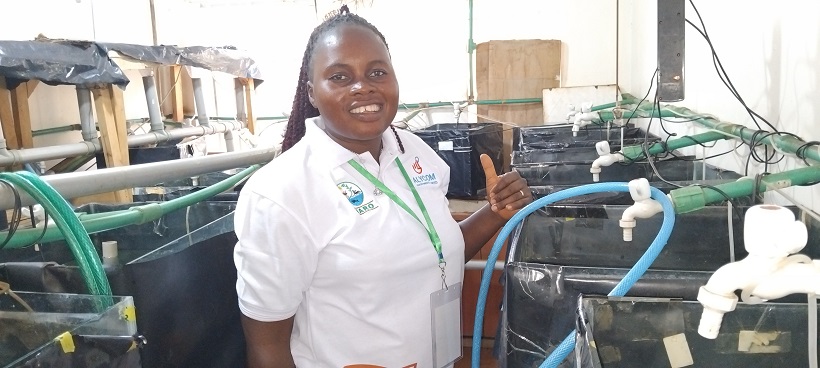
Under
climate smart fish farming farmers are encouraged to adopt aquaponics fish
farming where they rare fish and grow crops especially vegetables. This is
because the water used for rearing fish is recycled for the plants growth.
Quality fish feeding and value addition
Ms Egulance
Ganda a technician at the centre dealing fish feed formulation explained that
due to the scarcity of silver fish which used to be part of the fish protein,
the team is now concentrating in breeding Black Soldier lava which is dried and
mixed with other feeds.
The mixture
may include Maize barn, soybean cake among others but the mixture content
differs from Nile Tilalapia to Cat Fish.
For the case
of young fingerlings, it is advisable to feed them with powdered fish feed
mixture and the mature ones on pellets of different sizes depending on the size
of the fish.
Ganda notes
that the team has sensitized farmers to add value to the harvest fish in order
to earn more than selling it fresh
A good
number of farmer groups are now processing fish sausages and some are smoking
quality fish using the fish Klin which was distributed to them by scientists
from Agricultural
Engineering and Appropriate Technology Research Centre (AEATREC) Namalere.
At the
centre already the scientists are extracting fish oil and processing it. The
product they say is medicinal because is packed
with essential omega-3 fatty acids whose nutrients are vital for controlling
inflammation, supporting brain function and promoting heart health.