Most
farmers across the country usually treasure land on the foothills of mountainous
areas knowing they are fertile and can cause good yields.
These areas
include the Kigezi region in Western Uganda and the Rwenzori region in Eastern
Uganda.
However
much as land on the foot hills are believed to be fertile, there is a challenge
of water run offs during rainy season causing soil erosion which depletes much
of the soil nutrients becoming a problem in crop yield.
This
therefore leads to farmers adopting the necessary technology which includes
practicing terracing and contours to conserve the soil health.
Scientists
at Kachwekano Zonal Agricultural Research and Development Institute (KaZARDI) in Kabale have improved on the
terracing system which works far better in conservation agriculture.
Conservation agriculture
Amos Justus
Mutayomba Matungulu, a research scientist at KaZARDI describes Conservation
agriculture as a farming approach that emphasizes the preservation of soil
health, water retention and biodiversity while promoting sustainable
agricultural productivity.
He
notes that farmers practicing agriculture in hilly areas are encouraged to adopt
conservation agriculture practices which is vital for combating soil
degradation, climate change effects to ensure food security.
He says
several conservation agriculture techniques have been introduced across
different regions, supporting farmers in managing natural resources effectively
while increasing productivity. His team has specialised in improving the
terracing and contour system to improve farmer yields
Terracing
Technology development
According
to Mutayomba his team at Kachwekano Zardi have developed an innovation that
integrates a number of technologies to harness and address challenges farmers
are faced with concerning soil erosion. This includes contour reserve bends,
terraces and agro forestry practices.
How the
technology is made
According
to Mutayomba farmers in hilly sloppy areas have been practicing terracing and
contours before but in rather a rudimentary way
In
2023, the team under a project called BRIGHT funded by the International
Fertilizer Development Centre (IFDC) in the USA developed the technology mainly
to help farmers in Kigezi and Rwenzori region.
The
team identified sites at Kachwekano Zardi research Institute in Kabale, in
Kariba village in Rubanda district and in Nyarugono village in Bunyagabu
district.
After
identifying the sites, the farming community were mobilised to carry out the
landscaping together with the scientists in order to determine the category of
the ecosystem
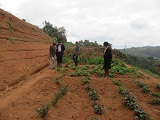
The team
then established Terraces where they constructed the foundation but maintain
the top soil. The next step is to level subsoil gravels, build the upland and
lower land, level the terrace, splash back the op soil and establish stable
beds.
What is
important to consider are the geological factors depending on the soil type,
hydrological factors where the level of water draining in the soil is
considered as well as the altitude.
This
therefore determines which agricultural crop fits in which specific terrace
design. A case in point is where the spacing of the terrace levelling for
Apples is expected to be 3 meters by 3 meters and for Irish Potatoes in 5
meters by 5 meters.
This
technology according to the scientists eliminates flooding and soil erosion and
it restores degraded water shade in a period of less than one an half years.
It also
restores lost nutrient and assures increase in crop yield because it
facilitates regenerative agriculture.
Farmers
can also use the water catchment in the water shades for irrigation during dru
season.
The
second technology which has been tested is contours, where grass bends, shrubs,
Agro forests are planted and tree hedges at the slopes to hold running rain
water.
Farmers
in the Rwenzori and Kigezi region growing assorted crops namely potatoes,
climbing beans, apples and banana among others have already adopted the
technology.
The
scientists are already working another technology which will help in minimising
landslides in hilly areas of the country.
The
technology called underground water pressure release will control underground
water levels rise which ends up causing landslides.
According
to Mutayomba, farmers living on hilly slopes end up covering natural paths
where water is expected to flow downstream. Once the cover these water paths
with soil, it will gradually cause holes and the heavy rains will soften the
soil causing landslides.
The
technology will create diversion of the ground water allowing the remaining
land to dry and stabilize.
The
technology involves establishment of structure including vertical trellises,
French drains and diversional tunnels to allow water uphill to flow.
Recommended conservation Agriculture Practices
According to Mutayomba as a team of
agricultural scientists handling solutions to address soil health for increased
yields, farmers are required to observe practices which include minimal
soil disturbance referred to as No-Till Farming.
This practice involves reducing or eliminating ploughing to preserve the
soil's natural structure and by avoiding soil disturbance, farmers help
maintain organic matter, reduce erosion and improve water infiltration.
This technique can also be used during times of drought to preserve soil
moisture.
Crop Rotation and Crop Diversification is
another method which helps improve soil fertility and reduce pest and disease
cycles.
Farmers rotate nutrient-demanding crops such as maize with
nitrogen-fixing legumes like beans, groundnuts and soybeans.
In areas such as Kabale and
Kisoro in South-western Uganda, where soil erosion and nutrient
depletion are major issues, crop rotation has proven to be highly beneficial in
restoring soil fertility and increasing yields.
Another practice is mulching
which involves covering the soil with organic materials, such as crop residues
or leaves, to reduce water loss, suppress weeds and protect the soil from
erosion.
This according to the scientists is highly adopted in Mbarara and Bushenyi districts
where mulching is used to conserve moisture in banana plantations and other
crop fields, contributing to sustained productivity even during dry spells.
The team recommends farers to adopt Agro-forestry which is the
integration of trees and shrubs into agricultural landscapes providing benefits
of improved soil fertility, erosion control for improved crop yields.
Trees such as Grevillea, acacia and fruit trees are planted alongside
crops. In regions like Mount Elgon and the Rwenzori Mountains, agroforestry
is promoted to reduce soil erosion on steep slopes and provide additional
sources of income through timber and fruit production.
It is recommended for farmers to plant cover
crops are grown to protect and enrich the soil during off-seasons.
Leguminous plants such as cowpeas, pigeon peas and clover are commonly
used as cover crops to add nitrogen to the soil.
In regions where rainfall is inconsistent, water harvesting techniques
such as rainwater collection and the use of small dams are essential for
ensuring adequate water supply during dry seasons.
The most applicable method for farmers on
slopes of hills and mountains is Contour Farming and Terracing.
Contour farming involves ploughing along the contour lines of slopes to
reduce water runoff and soil erosion. This practice is particularly useful in
hilly areas, such as Kabale and Mbale where terracing and contour
farming help preserve soil fertility and control erosion on steep slopes.
The local communities here benefit from reduced soil loss and better
water retention, which significantly improves crop yields.
Traditional
types of terracing practiced by farmers
Mutayomba
contends that Farmers in the hilly areas of Kabale district practice a
sophisticated, traditional form of terracing to manage steep slopes which
is essential for reducing soil erosion, conserving water and creating arable
land.
This system
is characterized by a forward-sloping terrace design, primarily developed
through long-term, intensive human effort, commonly referred to as progressive
or bench terracing.
Evolutionary Progressive Terracing: this is where farmers create terraces over
time rather than all at once. They start with a, contour bund or a trash line,
which gradually accumulates soil washed down from above, eventually forming a
flat bench-like structure.
Contour Hedgerows: This involves planting vegetation, specifically Napier grass across the
slope at intervals of roughly 15 meters. These grass strips hold the soil in
place and act as a .barrier that builds up soil behind them which becomes
stable
Tillage Erosion: The unique shape of the terraces is partly caused by the
traditional practice of hand-hoeing while facing uphill, which slowly moves
soil downhill over many years to settle against the contour bunds.
Bench Terracing Construction: This practice is where farmers build bench
terraces. This involves cutting into the hillside, removing topsoil, levelling
the subsoil and then returning the topsoil to the new level surface.
Integrating Complementary Techniques: Terracing is rarely used alone. It is
integrated with agroforestry.
The
practice has turned steep, otherwise unusable slopes into highly productive,
deep-soiled, and sustainable agricultural plots.
Farmer experience
Nr
Charles Byarugaba who comes from Katanga Parish in Kabale district is a
progressive potato farmer and seed producer.
He notes
that he has been engaged with the scientists in testing the terracing and
contour technology which he already implementing of his Irish potato farm.
“The
technology works well because the scientists sensitized farmers to follow the
spacing of the terrace construction depending on each crop type. The spacing
for Irish potato is different from beans, apples and banana,” he notes.
He
contends that farmers never observed spacing calculations for various crops
when constructing traditional terracing and this did not solve the challenge of
soil erosion and water retention to improve soil nutrient.