Goat farming in Uganda is a rapidly growing into lucrative agribusiness,
favoured for its relatively low management costs compared to cattle.
It is increasingly viewed as a viable commercial venture for boosting
household income but this comes with farmers wishing to venture into goat
farming to follow the best practices in order to succeed
In goat farm manual for farmers developed by experts from Valley
University of Science and Technology in Bushenyi, they state that many families
are taking goat production as a family business venture and revenue stream.
The experts acknowledge Mr. Vincent Lutwama, a dairy goat farmer of Austin
Farm in Bamunanika, Luwero district and production and Engineer Michael
Musasizi, JM GRINTA FARM, Busunju, who provided most of the information on
dairy goat farming
To the farmers most people are taking onto goat farming because goats
have a high multiplication rate since they produce twice a year and the Savanna
goats in Uganda have become the preferred exotic breed since it is believed
that they are hardier than Boer goats.
It is further stated that rearing goats in Uganda is generally easy
because most areas have a wide variety of shrubs, scrubby wood and grass.
Goats love to browse, their upper lips are incredibly mobile and with
the help of a strong tongue, goats can selectively grab and are able to avoid
thorns and spines.
Rearing goats in Uganda is mostly done on a free range basis except
those with a few goats in peri-urban areas.
Raising goats is a valuable part of a sustainable farm and goats often
fit well into the biological and economic niches on a farm that otherwise go
untapped.
They can be incorporated into existing grazing operations with sheep and
cattle and they can also be used to control weed.
Good production system
The
production system includes intensive (zero-grazing), semi-intensive, tethering
and extensive systems.
Zero-grazing is popular for maximizing land use, where one acre can support up to 50 goats.
Under this systems, the goats are housed and feed and water are provided to them. Under this system farmers keep large numbers of improved goats indoors. It is an agricultural system that aims to get maximum yield from the available land.
The bucks, does, and kids are kept in different compartments or houses and mating is controlled, where the farmer can decide which bucks can mate and the time for mating.
This
ensures that there is no crossbreeding and flock multiplication is controlled
but usually the challenge is that the number of goats produced is low.
Tethering Production System
Tethering describes a system in which goats are kept in a shed during night time, whereas during daytime they are tethered in the vicinity of the house, along the roadside or on public grounds.
Tethering of goats is practical only for very small herd because only adults are tethered, while young kids are often let loose. Often the sexes are not separated therefore mating is not controlled.
Extensive Production System
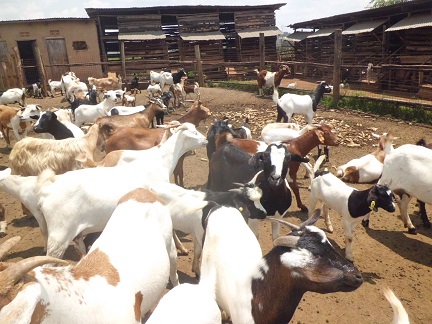
Extensive goat husbandry systems usually involve larger numbers of animals. The goats graze and browse large areas of land that are usually marginal in nature and are unsuitable for other agricultural use.
The system is more common in the arid and semi- arid climates and the system are common for meat production, but are rarely used for dairy goats, although some goats may be milked temporarily for family supply.
Breeding is uncontrolled and the goats are watered during the day at streams, lakes and ponds or water is provided from wells.
Farmers practicing this system usually obtain large amounts of goats which is good for income earning.
Semi-Intensive Production System
Semi-intensive goat production system is a mixture of both intensive and extensive systems. The goats are left to graze and also are provided with feed and water.
In some cases, the male goats are zero grazed, while the female goats (does) are grazed. The does are brought to the bucks for mating.
This is the system where construction of goat’s house is key though all systems require housing them for safety.
Tips for farmer to succeed
This involves Practical Experience on goat farming system before starting commercial goat business.
It is important to learn from existing farmers about management skills and experience of available staff and of veterinary personnel are important.
Select a very good Farm location and ensure that your selected location has all types of facilities for a profitable goat enterprise.
The necessary facilities for goat farming include the following source of fresh and clean water supply, easily available feed source, fertile field for crops, pastures both grasses and forage legumes and other green fodder species.
Feeding green fodder keeps the animal healthy, productive and reduces feeding costs.
Availability of full time labour, good transportation and veterinary service a market near the farm land so that you can sell your products easily and buy necessary commodities.
The acreage needed is determined by the number of goats being raised and to raise 500 goats, about 10 acres of land, including shed construction area, is often necessary.
If you want to begin with a small number of goats, say 50, you’ll need 1 acre of land. Fixed Capital is required for putting up farm structures like housing, fencing and equipment and
Circulating capital is required to finance the production cycle such as purchase inputs such as feed supplements, drugs, equipment, forage seed, irrigation equipment, building materials and fencing.
Choose the right goat breed especially for beef and dairy. Some of the available goat breeds are famous for tasty and nutritious meat and some breeds are famous for milk production. Dairy goats are raised mainly for commercial milk production or for family milk consumption.
They include local breeds which are preferred for adaptability, but there is a push toward crossbreeding with improved, faster-growing breeds like the Boer or Savannah which are considered hardy for better meat quality.
The nutrition involves quality fodder and recommended pastures include Napier grass, Lablab, Brachiaria, and Alfalfa among others
The marketing system indicates that there is a high demand for goat meat, both locally and for export markets, especially with initiatives aimed at improving goat germplasm in Uganda.
Construction of goat house
Mr Denis Duke Onyala who majors in goat house construction explains that constructing a proper goat house requires a focus on elevation, ventilation and protection from moisture to ensure high productivity and health.
The
most recommended design for Uganda’s climate, particularly to prevent pneumonia
and parasites, is an elevated (raised) wooden structure with concrete polls to
avoid insect infestation.
Requirements for a Goat House
The location is important and this includes high dry, raised area with good drainage to prevent water stagnation.
It must contain ventilation which must be positioned to avoid strong winds but ensure it allows good air to keep the house cool.
It must be placed near water sources and feed storage for convenience.
The floor should be raised 2 to 3 fit off the ground to keep the shelter dry and allow waste to fall below.
Allocate at least 15–20 square feet of indoor space per adult goat. A 40-square-meter shed can accommodate about 20 goats.
Partitions include separate sections for kids, pregnant does and sick animals.
The frame and Walls can be treated timber or bamboo to prevent termite destruction. And the roofing can be corrugated iron sheets or thatched roofs can work, but iron sheets with adequate eaves provide good protection from rain.
Slatted wooden or bamboo floors with gaps one index finger width are ideal for allowing droppings and urine to pass through.
Stone-built or concrete pillars provide strong, permanent support and elevated feeding troughs placed outside the sleeping area reduce contamination and waste.
Clean, accessible water should be provided and Kid Creep/Partition with warmth component is ideal.
The house must remain dry to avoid pneumonia and respiratory issues and treat poles to increase lifespan.
Ensure the structure is sturdy to protect against theft and predators.
A small-scale goat farm house can cost between Shs2 million to Shs5million to set up, depending on the number of goats.