Cattle are deemed infertile when they
are neither normally fertile nor completely sterile.
Experts note that interest in bovine
infertility increased with the introduction of artificial insemination in the
1950s and as the factors involved became known to farmers, herdsmen
physiologists and other workers took a keen interest in studying the same.
Experts say the causes of infertility
are many and can be complex.
They relate to the final stage of an
ovary where ovulation, fertilization, implantation and the development and
delivery of the foetus and its membranes.
Anything interfering with these
routines, such as diseases, poor nutrition, inadequate herd management,
hereditary and congenital factors, hormonal disturbances or environmental
changes, makes the animal infertile, if only temporarily.
Infertility and pregnancy challenges
in cows in Uganda are primarily driven by a combination of inadequate
nutrition, high prevalence of infectious diseases, poor management practices particularly
regarding artificial insemination and environmental stress.
In many cases, these
factors cause long calving intervals, repeat breeding and silent heats.
In a study conducted by scientists from Makerere University department
of Veterinary Surgery and Reproduction led by the late Dr Lawrence Miyingo
Kezimbira about the topic age at puberty in Nganda cattle under traditional
conditions in Uganda, they give details as published in International Atomic
Energy Agency.
Research process
Research into the reproductive
efficiency of Nganda cattle was carried out in a study by scientists where they
determine whether delayed puberty was a serious problem in Zebu cattle species
commonly known as Nganda heifers.
The team selected 60 Nganda heifers
and their crosses with the other local types and monitored its ovarian activity
to establish their ovary formation process.
The results indicated that over 50%
started cycling at about 2.5 years of age with nearly 90% of the heifers
beginning their sexual activity by 3 years of age.
To test whether the age at puberty could
be reduced by supplementary feeding and control of internal and external
parasites, 20 Nganda heifers 1.5 years old were selected in the second part of
the study.
The results proved that supplementary
feeding, deworming and spraying against parasites had a positive influence on
the initiation of sexual activity in pubertal Nganda heifers.
Indigenous breeds of cattle in the
tropics and subtropics exhibit poor fertility, late sexual maturity, low
conception rates, long calving intervals and poor weaning rates compared with high breeds maintained in
northern Europe and North America.
In order to try and improve this
situation, it is necessary to study each breed in its prevailing environment so
as to identify the limiting factors and thereafter to design a practical scheme
of improvement.
The level of management and the
availability of feed resources affect the performance of any breed of cattle.
Management of cattle
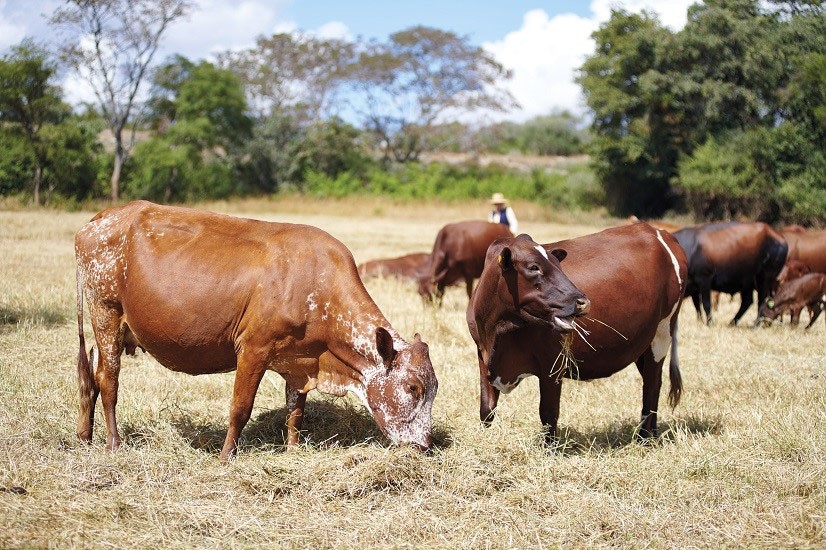
In Uganda there are two main ways in
which indigenous cattle are managed.
Small scale farmers keep an average of
about ten adult cows. They do not have fenced land but graze their animals
along roadsides
Farmers in more remote areas of the
countryside in typical cattle areas such as parts of Masaka and Ankole have
larger herds of 30-2000 animals.
Most of these farmers have fenced
farms, although a few cattle owners still move from place to place grazing
their herds.
These medium to large scale farmers
milk their animals only once in the morning and the calves are left to run
together with the dams so that they suckle all day.
At night the calves are housed although
supplementation is not usually practised.
Most of the small and large scale
farmers deworm the un-weaned calves at least twice. Older calves and adult
cattle are very rarely dewormed, especially in large herds, owing to the
expense. Most farmers in Uganda today control parasites by the use of
acaricides.
Disease and feed management
Prophylactic treatment against trypanosomiasis
is often given and control of other diseases depends on the effort of each
farmer.
The government enforces some
compulsory vaccinations, such as for rinderpest, foot and mouth disease and
contagious bovine pleuropneumonia.
It is unfortunate that there is as yet
no harvesting of excess pastures as hay or silage during the rainy seasons.
Hay and silage could maximize
production during the dry periods when green grass is scarce. Concentrate
feeding is not a common practice; animal performance could probably be
increased with such supplements.
The pastures available in Uganda
include a mixture of grass species and legumes mainly established naturally.
There are only a few areas where
pastures have been planted and they
include types of grasses commonly found are Pennisetum purpureum,
Pennisetum clandestinum, Chloris guyana, Panicum maximum, Themeda trianda, Hyparrhenia rufa,
Hyparrhenia filipendula, Setaria incrassata, Chrysopagon auchen, Digitaria scalarum and Brachria spp.
Reproduction of animals and infertility
challenges
There are only two reports on the
reproductive function of indigenous cattle of Uganda.
These identified, through abattoir studies,
the abnormalities that could cause infertility.
However, clinical field investigations
have been lacking and similarly there is no information available on endocrine
status.
The present study was therefore
designed to provide some of this information.
The study aimed to define the
approximate age of puberty and first pregnancy in Nganda cattle under typical small
scale management conditions.
What was considered most is the weight
of heifers at puberty; the weight of calves at parturition and the incidence of
infertility in cycling females, pregnancy loss and neonatal survival.
The influence of pasture quality,
parasites and the incidence of brucellosis in lactating animals is another
factor
The second part of the study examined
whether supplementary feeding, deworming against internal parasites and
spraying against parasites had a positive effect on the age at puberty, cycle
regularity, cycle length and the intensity of heat sign.
Results
Since two independent studies were
performed to investigate the reproductive efficiency of the Nganda cattle.
The resultson 63 year old Nganda
heifers indicated that they could be categorized into three groups, active open
heifers, pregnant heifers and inactive heifers.
The active heifers were those with
large ovaries. Their uterine horns had good tone.
Most of the active and pregnant
heifers had a good body score.
The inactive heifers were those which
revealed small, smooth ovaries with no follicular development and small,
toneless uteri.
These had a poor to moderate body
condition and in all, 51.7% of the heifers were pregnant at first palpation.
During the subsequent observation period
of one year, all the 22 heifers initially diagnosed as active and open
conceived.
However from this group 2 heifers aborted
at 3 months and 8 months of gestation, respectively.
Another heifer from the initially
pregnant group also aborted at 4 months of gestation and the owner blamed the
bull for having caused the abortion since he saw it serving the pregnant
heifer.
Part two the study indicated that
supplementation, deworming and spraying had a positive effect on the
reproductive performance of Nganda cattle.
In conclusion it can be stated that
delayed commencement of sexual activity is still a problem in Nganda type
cattle.
The extent of the problem is, however,
far less than with other indigenous types such as the Ankole, Nkedi and
Nkolomojo.
Good management involving the
provision of feed supplements, maintaining small herds and offering treatment
against worms, parasites and debilitating diseases such as trypanosomiasis
accounts for the relatively early sexual maturity in Nganda cattle.
Study comparison
Scientists from University of Nebraska
Lincolin found out that while several factors can play into a herd’s
reproductive success, management is usually the key factors.
The study which was published in the
French post dwelled on solutions which include concentration on nutrition ratio
given to the cows to avoid infertility.
Dr Mary
Drewnoski, beef and forage specialist from University of Nebraska is quoted saying
Protein or energy are usually the big rocks that are missing, especially in
young animals that may still be growing
She advised farmers to ensure that Heifers and cows
should be an increasing plan of nutrition during the breeding season as
established throughout the year.
Bull power and breeding
Farmers must know that females are just part of the
equation in that bull management is key and must ensure that there are enough
bulls in the herd.
Bulls should be tested four to six
weeks prior to turn out and bulls may be infertile.
This is because the sperm production
is a 61-day process, so injuries that occur earlier in the course of the year may
not show up during a Breeding Soundness Exam, if the exam is done too early.
Young animals which are still growing
need to be fed well for them to perform. Farmers must ensure the cows have good
body weight because most thin cows tend to be infertile.
Other nutrients
Farmers must ensure that they provide
animals diets comprising of Vitamin A and phosphorous including minerals.
Infections
It is important for farmers to keep
disease infection out of the herd and this can be done by vaccinating the
animals by veterinary doctor.