Northern
Uganda experiences floods and drought, impacting water supply, hygiene and
health and livelihoods.
These floods
and drought seem to become more extreme, possibly linked to climate change
Climate change worsens water scarcity,
floods and contamination and a resilient water
system is fundamental for human health, socio economic development and
community adaptation to climate impacts.
Ensuring reliable
safe and accessible water for drinking, sanitation and other uses is crucial
for a community to withstand and recover from climate-related shocks like
droughts and extreme weather events.
This is the thinking of experts from the SVV Netherlands Development
Organisation, as such coming up with a three year project of climate resilient
clean water initiative in Northern Uganda climate-resilient and sustainable water, sanitation
and hygiene (SWaSSH4A).
The project
that been implemented in partnership with Global Forum for Development
(GLOFORD), Caritas Lira and the local governments of Alebtong, Dokolo, Kole and
Lira, with funding from the Austrian Development Cooperation worth 1.7 million
Euros has improved access to inclusive, services for people
across Northern Uganda.
Overview of Project implementation
The project
manager John Robert
Okelloexplained that SWaSSH4A is the latest in a series of Water, Sanitation
and Hygiene
(WASH) interventions, following Improving Water Supply
Sustainability (IWAS I & II) and Sustainable Sanitation and Hygiene for All
(SSH4A).
Together,
these efforts have established a strong foundation for sustainable water and
sanitation systems that put communities at the centre of development.
The approach focuses
on strengthening community and local institutional capacity for managing and
maintaining water sources, implementing sustainable financing mechanisms for
repairs and providing technical assistance for climate-resilient water system
design and implementation.
The project
which is ending soon to has impacted on more than 238,581 people who have gained access to safely
managed sanitation through the construction and upgrading of over 6,000
latrines, while 42,905
people benefited from water rehabilitation points.
An additional 324,750 people maintained access to safe water
through strengthening operations and maintenance systems.
Improved
hygiene behaviours led to 26,635 people installing handwashing facilities with soap and water
near their toilets.
To sustain
these gains, 34 Sub-County Water
Supply and Sanitation Boards were equipped and trained to improve service
delivery, alongside four Hand Pump Mechanics Associations and 120 trained mechanics, including women
and youth, who now manage and maintain rural water supply infrastructure.
The head of the
Austrian embassy in Uganda Dr Katja Yvonne Kerschbaumer notes that it the
fundamental right for every Ugandan to have access to safe water regardless
where they leave though this is infringed by climate change effects.
Giving the statics,
she indicated that between 61%-^9% of people leaving in rural areas have access
to safe water compared to 71-79% in urban areas.
However she is of the
view that more work has been to done to ensure more people in rural areas
access safe water including farmers who can use water for food production.
To her the project
addressed some of the challenges caused by climate change effects that hinder
the rural communities from accessing safe water especially in Northern Uganda.
How climate change impacts water
supply
Okello explained that climate
change leads to more frequent and intense droughts, reducing the availability
of surface and groundwater and intense rainfall can overwhelm water systems,
causing floods that contaminate water sources and damage infrastructure.
Changes in rainfall patterns and
increased runoff can carry more pollutants from land use and land degradation
into water sources, a problem exacerbated by factors like deforestation and
agricultural practices.
When water sources are scarce or
polluted, it costs more to provide clean water due to the need for alternative
sources, more storage and advanced treatment. These
are some of factors affecting the identified districts in Northern Uganda.
How
resilient water systems enhance climate resilience
Access to clean water and
sanitation is a human right and a foundation for health. Without it communities
are more vulnerable to water-borne diseases, especially as climate change can
increase disease risk.
A secure water supply is vital
for agriculture, businesses and daily life and without it, a community's
ability to thrive is compromised.
Resilient water systems, such
as those with diversified sources and robust infrastructure, allow communities
to better manage the effects of both too much and too little water.
Competition for scarce or
contaminated water resources can lead to local and regional conflicts and ensuring
reliable access can mitigate this risk.
Building a climate-resilient water supply
Okello further explained that his team worked with local government leaders in the four districts and this was mainly to coordinate the communities
The team managed to implement
integrated water resource management systems, improving watershed management.
In as far as infrastructure is concerned the team managed to ensure
that the designed to withstand climate impacts, such as flood-proof storage and
resilient distribution networks was observed.
This required sensitizing the
communities to construct their pit latrines on land which is not prone to
flooding to avoid the structures being washed away.
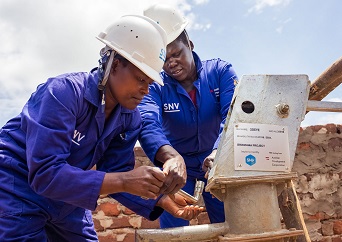
The same applied to the
rehabilitated boreholes and newly constructed ones as well. The materials used
to construct and rehabilitate the boreholes were carefully selected and the
team choose to use steel made materials which cannot corrode easily.
The team
rehabilitated 54 boreholes in 324 counties. Since safe water issues go hand in
hand with hygiene, this means safe water sources must be available to improve
sanitation. This will reduce disease burden brought about as a result of climate
change effects.
The previous
projects according to Okello looked at the challenge of water supply but this
one addressed the issue of hygiene.
To address the
challenge of water for farm production especially during drought, the team is
looking at setting up motorised systems which farmers can use to pump water for
irrigation.
Farmers need
water for fish farming and those keeping livestock, water is crucial.
Local community
voice
The resident
district commissioner for Dokolo District Ms Jillian Akullu Omara notes that
the challenge of climate change effects in Northern Uganda is immense and this
affects water safety for the communities.
To her the
district water points are not enough to serve the communities and the
rehabilitation done by SNV team was timely
In her district
there is only one water point in terms of borehole per every county and this
cannot serve the entire community including schools.
She called upon
the government to collaborate with development partners to enough more water
points are constructed in districts with integration of schools.
To help mitigate
the climate change with frequent droughts in Northern Uganda she is of the view
that dams must be dug to provide water for livestock farmers and irrigation
schemes to cater for farmer needs.