In Uganda
most farmers dealing in the coffee value chain are mainly adults who are not in
the youth bracket.
However this
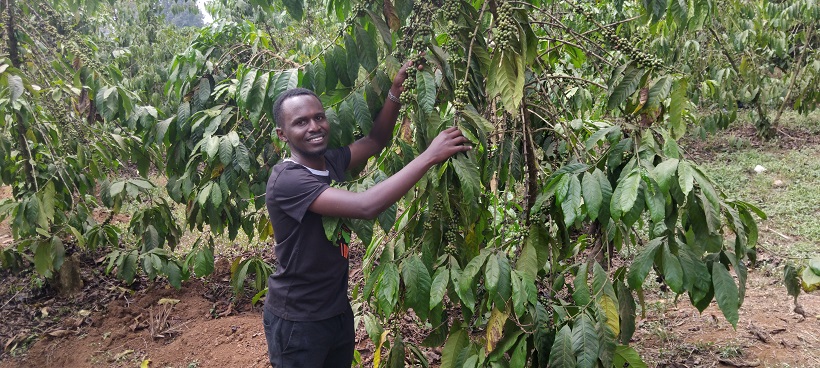
trend is changing because a good number of youth are now engaged in coffee
farming and agribusiness related activities in the coffee value chain.
As such a
number of development partners have come on board to train the youth on best
practices right from the coffee farm to harvesting and to value addition in a
bid to create employment and to earn income.
One such
initiative is where the Young Farmers Federation of Uganda (UNFYA) is
partnering with development partners to conduct activities of training selected
youth in Uganda and in Germany about strategies of embracing the coffee value
chain as a business.
Coffee exchange programme
The
German-Ugandan Youth Exchange for Sustainable Economic Partnerships in the
Coffee Sector is an innovative youth exchange project that will be conducted
from June 2025 to March 2026.
The Project
Coordinator Samuel Magezi explaining to ScienceDigest25 notes that the project at
its core is the exchange between young people from Uganda and Germany, who
together will learn about the entire coffee value chain from cultivation in
Uganda to marketing in Germany.
The project
focuses on the question of how young people from both countries can acquire
knowledge for innovative, sustainable business ideas through practical
experience and to what extent the partnerships that emerge can contribute to
fair trade conditions and improved incomes for Ugandan coffee farmers.
This is
because intercultural exchange plays a central role in understanding global
economic relationships.
He notes
that as one of the most traded agricultural products worldwide, coffee
represents an important source of income for many producing countries, while
challenges such as unequal distribution of profits along the value chain and
precarious working conditions persist.
There is significant
number of opportunities which exist for young people to maximize their benefits
from the coffee sector, not only in production but increasingly at downstream
stages.
Trained
youth are best positioned to adapt modern technology in production and
post-harvest handling.
Provision of
services by groups have been successfully introduced, including in the
rehabilitation and maintenance of coffee gardens and the management of storage
facilities.
The exchange
takes place on equal terms and enables a change of perspective that is
enriching for both sides. Participants become multipliers for sustainable
development and fair trade.
Program
Structure and Content
The exchange
spans a period of ten months and combines digital collaboration with two
intensive face-to-face learning phases.
At the
beginning, German and Ugandan participants are divided into pairs that work
together throughout the entire project.
After a
digital preparation phase with workshops on coffee production and intercultural
cooperation, the German participants travel to Uganda for 16 days, where they
gain practical experience on coffee farms and visit different stations of the
local value chain together with their Ugandan partners.
In the
subsequent intermediate phase, the pairs develop initial business ideas in
regular online meetings.
In December
2025, the second face-to-face phase follows in Germany, where the Ugandan
participants will go to gain insights into the German coffee industry and work
with their German partners on concrete business concepts.
The
conclusion is a digital presentation of the developed concepts to industry
representatives, offering participants a platform to present their ideas for
sustainable trade partnerships to a professional audience.
Target
Group and Participants
Five young
people between the ages of 19 and 30 have been selected to participate from
each country.
The
participants from Uganda come from the field of coffee production and young
coffee farmers with university backgrounds, students of agricultural sciences
or young entrepreneurs in the coffee sector.
The German
participants have backgrounds in agriculture, economics and some are operating
come coffee roasteries, import companies and cafés.
The project
is funded by the German Federal Ministry for Economic Cooperation and
Development (BMZ) to the tune of 19,000 Euros.
Training progress
A team of
five youths from Germany are already in Uganda for practical sessions of coffee
farming.
Part of
their sensitization exercise was experts from the National Union of Coffee Agribusinesses and
Farm Enterprises (NUCAFE) training them about the coffee value chain best
practices and opportunities for the youth.
The
manager green coffee unit Ms Mercy Kemigisha explained to the team that NUCAFE
is company that deals directly with coffee farmers across the country totalling
2million and 2.7 million farmer Associations.
The
modal is that the farmer Association bulk coffee bean which is well dried and
is sold to company.
But
before the coffee beans are processed for sell, the company reaches out to the
farmers by engaging its agronomists to take them through best practices in
order to obtain quality coffee bean
Coffee processors
are given hurlers which they can use for processing raw coffee bean to the
required quality.
The
price offered to the farmers is Shs25, 000 per kg for grade AA for Arabica
coffee and Shs22, 000 per kg for grade AB.
The
price of Robusta coffee grades 15 and 12 is Shs11, 800 and Shs11, 500
respectively.
The
Association managers are given smart phones to access information about market
prices and weather forecast among others.
The
team also engages the youth in skilling them mainly in value addition with a
target of creating jobs for themselves.
Most of
the youths are agricultural students in Universities namely Ndejje and Makerere
University.
Kemigisha
urged the Germany youths to grab all the knowledge from resource persons and
their twin colleagues since they participate at the ending point of the value
chain not knowing how quality coffee is attained before it reaches the cup
after brewing.
The voice of
the youths
Julius
Saazi is the general manager of Opportunity Manya Transformation Services Ltd,
a coffee agribusiness company based in Rakai district.
The
company operates coffee nursery bed for varieties namely KR1, 3,4,5,6,7,8,9
and10 which can accommodate up to 1000 seedling,
His
team conducts coffee bean processing since they own a coffee hurling machine.
The concentrates in hurling quality coffee beans of grade AA of Arabica coffee
and grade 15-18 of Robusta coffee.
The
team participates in the value chain up to brewing because they do roast grind
and brew for coffee lovers. They also package the coffee in powder form in
different packages sold at different prices.
Saazi
and team work with farmers whom they have identified with the greater Masaka
but for Robusta Coffee they source it farmers mainly in the Elgon region.
He
noted that the Germany youths are mainly those upgrading their studies with
focus on European Union Deforestation
Regulation (UEDR).
It's a European Union law aimed at preventing the sale of products in
the EU market that are linked to deforestation and forest degradation.
He contends that although Ugandan coffee farmers do not practice coffee
farming in deforested land, they have since complied by making sure the
Ministry of Agriculture registers and them and mapped their lands as well.
Judith Kraemer is a Germany youth working with Fair Trade Company as a
certification officer for coffee farmers in the global South.
She says, she has never seen a coffee plantation and this is an
opportunity for her because she will be able to identify challenges farmers are
faced with to ensure consumers abroad obtain quality coffee.
Her company mostly sources coffee from Brazil but this sexercise will
open opportunities for Ugandan coffee since they source coffee for various
countries namely Australia Switzerland and Germany among others.
Challenges
and opportunities in the Coffee sector
Kemigisha explained that there are a number of opportunities in the
coffee sector including farmers being part of the 20 million bags to be
attained by 2030. This means they must be part of the value addition and
industrialization process.
This means there will be expansion in the domestic market and
internationally in countries such as China and India.
The challenges include dissolution of the Uganda Coffee Development
Authority whose experts were always on ground to guide the farmers.
Others are climate change impacts of prolonged drought and flash floods
which affects coffee yields.
Quality inputs are a challenge with adulterated inputs being sold in the open market as well as lack of market infrastructure and middle men offering low price to the farmers