Agriculture is a key sector that significantly contributes to the national economic development, poverty reduction and livelihoods of the farming communities
It is a
sector that enables food and nutrition security for the majority of Ugandans
However
according to the 2018 report from the Ministry
of Agriculture, Animal Industry and Fisheries (MAAIF), climate change is a reality and has
adversely impacted agriculture and other natural resource.
The report
states that over 96% of farming households in Uganda depend on rain fed
agriculture making them highly vulnerable to the adverse impacts of climate
change and variability.
Climate
change distorts the length of rainy seasons making the farmers uncertain on
when to prepare land and when to plant crops.
This shift
in rainy seasons negatively affects water availability for agricultural
production leading to reduced crop and pasture yields.
The foreseen
challenge is meeting the growing population’s food demand which calls for
increased food production amidst a changing climate.
However,
Uganda’s farming systems are not sufficiently developed to adequately adapt to
or cope with the impacts of climate change.
This trend
is the same for the Western part of the Country particularly the Districts of
Kikube and Kagadi in Bunyoro region.
This is what
Climate smart agricultural scientists discussed during the National launch of
the Integrated Mechanism for Protection and adaptation to Climate Change
threats (IMPACT) project for the districts of Kikube and Kagadi.
Seeds of
Gold interacted with the scientists and stakeholders and below are the details.
Background
The project
Programme Manager Gerald Tumwine explaining the background of the entire
project notes that, this is a project that will run for five years with funding
from the Austrian Ministry for Climate Action, Environment, Energy, Mobility,
Innovation and Technology.
The money
worthy 1,971,083 Euros is co funded with the Jane Goodall Institute in Uganda
and the project will be implemented in collaboration with Ministry of Water and
Environment and the leadership of the local government in the two districts.
The
executive Director Jane Goodall Institute Dr James Bwamukama explained the
background of the institute saying Jane Goodall came to Africa in the 1960s and
settled in Gambia sensitizing Africans about the importance of Chimpanzees as a
natural resource.
That time
there was plenty of forest cover but in the 1980s when she moved across Africa
including Uganda, the natural forest cover was dwindling and affecting farming
communities due to climate change effects.
It is until 1977
that Dr Jane Goodall and colleagues formed the Jane Goodall Institute in the
USA to help address the challenge of climate change in natural resource
management including agriculture.
In Uganda
the Institute was started in 1991 focusing on Biodiversity and conservation of
human biodiversity but the current project is focusing on promoting climate
smart agriculture.
Others are
protecting natural based livelihood, reducing dependency on the environmental
practices, restoration of degradable forests, wetlands, efficient energy use,
enhancing water security by building resilience against rain fall patterns and
raising climate change awareness among others.
Reasons for the Project
Tumwine explained
that 60% of the catchment in Bunyoro region especially the two selected
districts experiences water scarcity due to the prolonged drought periods.
The rain
fall projection indicate shift in rising seasons by 15- 30 days with rising
temperatures of 0.133 degrees Celsius to 0.24 degrees Celsius per decade.
The
population growth in the catchment is 5.5% contributing to high demographic pressure
Citing the
World Bank figures of 2023 it is indicated that 24% to 39% of the population is
in the Nkusi river catchment running through the districts of Kibaale,
Kakumiro, Kakube and Kagadi in the Albertine region.
The available
water supply for humans and agriculture for the area is 1,095.08 cubic meters per
person per year well below the recommended 1,700 cubic meters.
The forest
cover declined by 75.2 % between 1995 and 2017 and wetland cover declined by 70.3%
from 1995 to 2017.
Riverbank
degradation is accelerating soil erosion, increasing sediment loads in rivers.
Soil loss is currently at 69,800 tons per year and is projected to rise to
292,600 tons per year by 2024.
The overall
goal of the project is to build resilience of both communities of the River
Nkusi catchment and the ecosystem they depend on, to the negative impacts of
climate change.
The Outcomes and deliverables
The
scientists expect to restore the forest cover, wetlands and riverbank ecosystem
around the catchment.
The
communities especially those practicing agriculture have diversified
livelihoods and will be sensitized to respond to and recover from climate.
Deliverables
The
deliverables include the communities working with five sub catchment management
committees to enhance engagement and suitability.
Others are operationalisation
of the wetland management plans in the five catchment areas.
Restoration
of 1,765 hectares of degraded river banks and forest zones in river Nkusi
catchment as well as restore 3,990 hectares of woodlots and agroforestry and
this will be done through lifeline tree planting.
Another
deliverable is that the team will train 4,000 farmers in the catchment area
about climate smart agricultural practices including providing them with
climate resilient inputs.
About 10,000
farmers will be supported to access micro irrigation schemes and fourteen
thousand households will receive timely information every quarter about climate
change through early warning systems.
Communities
will be engaged in climate change related awareness through community radio
stations about three thousand school children will be educated on climate
change education, through demonstration gardens of various crop species
Others are
training 7,500 household in improved cook stove production and five community
groups equipped to market produced brickets.
There will
be twenty five improved water sources rehabilitated to benefit 4,500 households
Climate smart agricultural practices
Dr Peter
Apell the programme director at Jane Goodall Institute explained that his team
has performed similar programmes with the help of the Austrian government since
2017 and this is a continuation of the same.
In the
previous programmes which were implemented in the districts of Hoima, Masindi,
Bulisa, Kibaale and Kyangwali refugee settlement camp over ten thousands
benefited from adoption of improved agriculture technologies. The same will
apply in the two selected districts.
This time
the focus is on adoption of climate resilient crops such as Maize, beans, green
vegetables, fruits and livestock namely goats and cattle which are tolerant to
drought.
In terms of
assorted crop seeds, the parent seed is obtained from the National Agricultural
Research Organisation (Naro) which is distributed to the farmer groups who
multiply the same and keep in the community seed banks.
Farmers who
contribute a recommended amount of seed will obtain the same during planting
season.
Best practice for adoption
Farmers will be
sensitized to adopt conservation agriculture by practicing crop rotation, intercropping,
mulching and reduced tillage of the land.
They will be
sensitized to adopt agroforestry through tree planting which can also be
planted at the water basins, application of manure as well as planting
drought-resistant crop varieties.
Others are integrated
soil fertility management by applying compost manure in the farms and water
harvesting techniques to improve resilience to changing weather patterns
and enhance productivity while mitigating climate change.
The
scientists in collaboration with Uganda National Meteorological Authority (UNMA) will provide
early warning information to the farmers where in each session data will be shared
on specific plant species.
According to Dr Apell
those who listen to information on radio and weather alerts on their phones
usually succeed and attain better yields.
The scientists have
set aside about Shs250 million to implement the climate smart agriculture
initiate.
Part of the
initiative will be to drill boreholes for farmer groups which they can use
during dry spell to irrigate their crops.
Farmers will be
expected to plant over 6 million trees with 77% survival rate and bore goats
will be distributed to farmer groups in the two districts.
Ongoing initiatives from the
two districts
Ms Ann Mugisha is the
Natural Resources officer Kikube district and she explained that in as far as
prolonged dry spell is concerned it is real in her district.
This can be attested
by farmers in Kyangwali refugee settlement failing to harvest maize last season
because it was affected by drought.
The district has to
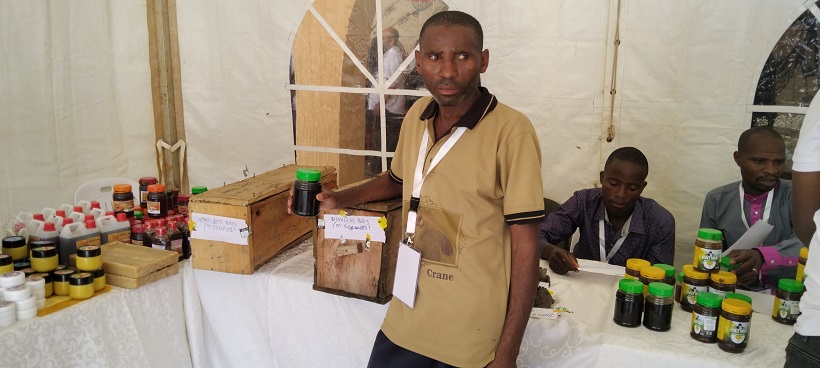
device means by supporting alternative livelihoods where farmers living around
Bugoma forest reserve were given bee hives to engage in bee keeping instead of
encroaching on forest reserve.
Honey processing
equipment has been installed for Kikube community at the town council
headquarters where farmer groups come to process their honey for onward
marketing.
Meanwhile in Kagadi
farmers are encouraged to practice agroforestry by allocating land both for
crops and tree planting. They mainly grow pine and Eucalyptus but many are also
growing natural trees for their own woodlot
Farmers have also
adopted first growing crop varieties especially legumes that grow within a period
of three months