How scientists have interested Sweet
potato farmers to embrace value addition
Sweet potato is considered as an important crop and it is ranked as the fourth most important crop in Uganda in terms of production volumes totaling to over 1.8 million metric tons after maize, cassava and bananas
This is according to
the Uganda Bureau of Standards (UBOS) statistics of 2016.
It is regarded in
Uganda with a reported per capita consumption 73kg person per annum
In addition to food,
sweet potato is an important commercial crop contributing to incomes of farmers
in Uganda.
It is grown in all
regions of Uganda on 55% of root and tuber arable land.
The major producing
districts by region, in descending order include Iganga, Bugiri, Nakasongola
Gulu, West Nile and Kyenjojo among others.
Sweet potatoes in
Uganda are marketed principally as fresh roots and consumed in steamed, boiled,
fried or roasted form.
However Scientists
from the National Crops Resources Research Institute NaCRRI have been engaging farmers
across the country to embrace sweet potato value addition which has been
adopted by a number of farmer groups across the country.
This was revealed
during the first ever East African Agribusiness Expo which took place at NaCCRI
in Naumlonge under the theme “Fostering Wealth Creation, Resilience and
Sustainable Agriculture through Agribusiness and Innovation” and below are the
details.
Background
The programme leader
Root Crops at NaCRRI Dr Bernard Yada explained his team has been improving
Sweet Potato varieties for pest and disease resistance, drought tolerance and
nutrition over the years.
However the improved
variety breeding programme later intensified with scientists breeding varieties
against weevil infestation through extracting DNA and making crosses to reduce
the breeding period from 10 years to five years.
A number of varieties
have been released which farmers are growing namely, orange fleshed sweet
potato variety such as NASPOT8, 11, 12, 13, and NAROSPOT1, 2, 3 and 5.
Additionally, other
notable releases include NASPOT 7, 9, 10, and Dimbuka-Bukulula. Some of
these varieties are biofortified for vitamin A namely NASPOT 7 and 8.
Some of the land race
varieties are Dimbuka, Sukai, Tanzania and Kawogo. They most widely cultivated due to their
sweet taste, high dry matter content and durability.
Most people sell it
fresh and consume it in steamed, boiled, fried or roasted form. But farmers are
now adding value to the same.
Why agribusiness farmer show
case
The Director of the
Institute Dr Titus Alicai explained that the Institute has conducted the Expo
in collaboration with the East African Grain Council to expose farmers to all
the grain, seed and seedlings which have been developed by Naro Institutes in
Central Uganda and elsewhere.
He contends that as
scientists they develop crop varieties mainly for food security and nutrition
for the uptake of all Ugandans
The focus is on
stress tolerant crops free from pests and diseases in order for farmers to
obtain good seed and seedling for increased yields.
Giving the
achievements of the Institute he pointed out that so far his scientists have
released over 90 varieties of different crop varieties over the last ten years.
This accounts to 2.4 million metric tons to 4.5 million metric tons with maize
yields increasing 2.5 tons per hectare fetching 89 million US dollars per annum
Beans alone fetches 17 million US dollars per annum and rice production has increased from 110 metric tons per annum to 310 metric tons per annum accounting for 70% of rice produced locally.
The Deputy Director General
Agricultural Technology Promotions Dr Sadik Kassim noted that scientists
working for Naro must innovate by developing agricultural products which are resilient
to climate change and suitable for agro industrialisation.
This is in a bid for farmers to
produce not only for home consumption but for export as well
He called upon the Ministry of
Agriculture Animal Industries and Fisheries to continue advocating for higher
budget for the Institution because the current staff is not enough to serve the
country with only Shs300 billion per annum.
The East Africa Grain Council
executive Director Geral Masida explained the challenges farmers are facing in
multiple tax charges when exporting their produce across the region.
He promised for his team to continue
talking to the heads of states across East and Southern Africa to desist from
charging overwhelming taxes on farmer produce
The sweet potato value chain
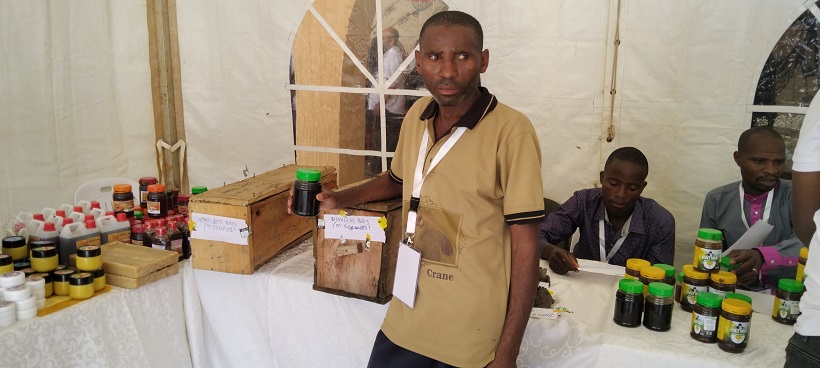
At the symposium, the
team demonstrated sweet potato value chain right from the farmers who were
teaching the best agronomy practice to farmers and students up to products which
they have processed out of sweet potato flour.
Dr Yada explained
that when his team develops the varieties, they ensure it is clean from viruses
in order for farmers not to plant infected vines
The breeding process
starts from the Laboratory to obtain early generation seed where the seedlings
are transferred to the screen house for selection.
The seedlings are
then transferred to certified farmers belonging to their cooperative unions.
These selected seedling operatives will further multiply the seedlings which is
sold to individual farmers for planting.
Farmers representatives speak
out
Mr Tito Wanale from
Buyende aged 41 is a farmer growing sweet potato and multiplying seedlings.
He belongs to Buseko
seed producers and cooperatives union with 108 members and he is the
chairperson.
He notes that out the
total number of members, they are six who are seed multipliers.
They are multiplying
varieties namely Naropt1, 3, 6 and 7 and Naspot1 and 8, Tanzania and Kabody.
He has been growing
the land races for the last 13 years but four years he began multiplying
seedling (vines) on 3 acres of land out the total 15 acres he owns where he
uses the rest of the acres for growing sweet potato.
The other 5 seedling
multipliers do it on 1-2 acres of land but are able to supply all their
members.
He contends that in a
season the seed multipliers usually produce 10 pickups of potato vines which is
sold in sacks and each sack is sold at Shs15, 000.
In his case he is
able to produce 300 sacks of sweet potato tubers per season and each sack is
sold at Shs180, 000 and Shs200, 000 depending on the season.
He says he has been
dependant on sweet potato farming and has been able to educate his 6 children
from the proceeds.
He however notes that
there is the challenge of prolonged drought leading to ow yields and recurrent
pest and disease burden.
Ms Betty Muwuma aged
62 is from Kamuli district and process sweet potato flour and leaves to make
tea ingredients.
When processing Sweet
potato flour, she is able to add ingredients such as roasted soy bean flour,
rice flour and maize flour to come up with baby foods.
She belongs to the
same farmer cooperative where they have allocated 10 acres of land for growing
sweet potatoes which is processed into flour.
On her part she is
able to process flour where she mixes 100 kg of sweet potato flour, 50kg of
rice and 100kg of maize. She packages them in 500grms which is sold Shs10, 000.
The same applies to
the tea leave ingredients which is packaged in 100gms and sold at Shs5, 000.
Ms Beatrice Okiror
Ariko is a manager in one of the bakeries namely JB management Foundation where
the team is processing bread using orange fleshed sweet potato. Because it
contains Vitamin A food nutrient good for the body.
The team initially
started a bakery in Arua City which is the mother bakery capable of producing
300-400 big loafs each sold at Shs5,00 and the small round bread production is
700 per day and sold and Shs7000 per package
Due to the
overwhelming demand, the team opened up a branch in Kampala and Yumbe districts
respectively.
Apart from processing
bread, they are processing cookies and daddies. The composition is that 40% of
the flour is orange fleshed sweet potato flour or cooked and mashed with 60%
wheat. The idea is to promote farmer grown products and also to reduce uptake
of gluten in wheat.