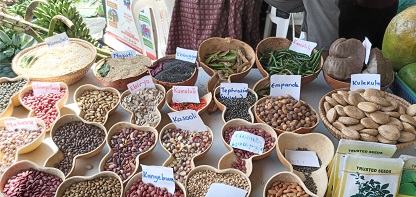
It is a reality that there are crops considered as orphaned because there is no government effort in considering them amongst priority crops yet they contain immense income and nutritional value
Experts contend that despite being
endowed with a variety of crops and crop species, the majority of which are
important for food and agriculture, Uganda’s food and nutrition security
situation remains worrying.
Background
The United Nations Food and
Agriculture Organisation (FAO) has already warned of a looming food and
nutrition crisis in Uganda.
According to FAO, Uganda could be the
next country after Somalia, Kenya, Ethiopia and Djibouti to be hit by the same
sort of alarming malnutrition and drought conditions.
This warning comes at a time when
increasingly, there are so many cases of malnutrition and malnutrition-related
diseases and deaths being reported.
According to a 2010 study, the
proportion of Ugandans unable to access adequate calories has generally been
increasing.
The study points out that 38% of
children under 5 years suffering from chronic malnutrition, 16% suffer from
underweight and 6 per cent suffer from acute malnutrition.
It concludes, that food insecurity and
the double burden of malnutrition are on the increase and that income and
wealth disparities are also increasing.
It is instructive to note that
majority of the food insecure, hungry, poor and vulnerable Ugandans live in
rural areas and depend on agriculture for food, income and livelihood.
Part of the problem is that
government, the private sector and development partners often focus their
efforts in the fight against food insecurity and hunger on a few major crops
that are considered important for food security.
They often ignore or give very little
attention to orphan crops such as mushrooms, yams, indigenous fruits, millet,
sorghum and vegetables among others yet millions of Ugandans in the rural
marginal areas rely on these crops for their nutrition and livelihood security.
If given the necessary policy
attention, these crops have great potential not only to improve the food and
nutrition security of the people in rural areas but also to provide and improve
income opportunities for the people.
If you're looking for crops that require minimal
water, you'll want to consider the climate and soil conditions of your area
first. However, generally speaking, some crops are known for being more
drought-resistant and can thrive with less water. Here are a few options:
These observations are made by Dr Ronald Naluwairo
in one of the Advocates Coalition for Development
&environment (ACODE) Policy
briefs titled “Investing in orphan crops to improve food and livelihood
security of Uganda’s rural poor”
Crops considered as orphaned
Dr Naluwairo identified some of the crops as Millet
which is highly drought-resistant and can grow in poor soil conditions with low
water availability.
Sorghum: Similar to millet, sorghum is another
hardy crop that can tolerate dry conditions and still produce a good yield.
Millet and Pearl Millet: They are rich in Iron and
Zinc and thrive well is drought prone areas
Green grams, Cowpeas and Pigeon peas are some of
the beans known for their drought tolerance. They can grow in very arid
conditions and also improve soil fertility by fixing nitrogen.
Cassava: Cassava is very adaptable to arid
conditions and can grow on marginal soils. It's a staple crop in man
Barley: It is an industrial crop used by brewing
industries and it is tolerant dry conditions than other grains like wheat and
maize.
6. Sunflowers: They are not only drought-resistant
but also deep-rooting, which allows them to access water from deeper soil
layers.
Fruit trees such citrus and quava which are
nutritious and can grow in drought conditions.
The Role of Orphan Crops in National
Development
The expert describes orphan crops as
those crops which have great prospective for food production and development,
but whose potential is not adequately appreciated and fully exploited.
Orphan crops are also often
interchangeably described as minor crops, neglected species, underutilized
species, or under exploited species.
They are described as minor to signify
the fact that they have a small commercial value of production and trade compared
to the major crops
Neglected implies the fact that
compared to the major crops, orphan crops receive very little research and
development attention.
As such, majority of them are
inadequately characterised and generally have very little scientific
information known about them.
Consequently, these crops remain
underutilized in national development. A key point to emphasise about orphan
crops is that they vary from one locality to another.
What may be an orphan crop in Uganda
may be a major crop in Kenya and Rwanda. Even within a particular country,
orphan crops may vary from region to region, although a number of crops may cut
across regions
Common Features for Orphan Crops
The experts say orphaned crops represent
an enormous wealth of agro-biodiversity since they have great potential for contributing to
improved incomes, food security and nutrition and for combating the ‘hidden hunger’
caused by micronutrient such as vitamin and mineral deficiencies.
They are strongly linked to the
cultural heritage of their places of origin and are mainly local and
traditional crops with their ecotypes and landraces or wild species whose
distribution, biology, cultivation and uses are poorly documented.
They tend to be adapted to specific agro
ecological niches and marginal lands. They have weak or no formal seed supply
systems.
They are recognized to have traditional
uses in localized areas and are collected from the wild or produced in
traditional production systems with little or no external inputs.
They receive little attention from
research, extension services, farmers, policy and decision makers, donors,
technology providers and consumers.
They are highly nutritious with proven medicinal properties or other multiple uses for human health.
The need to promote orphan crops
The reason
why these crops must be promoted is that majority of these crops and their
species are often grown by the poor farmers and communities in marginal and
fragile environments such as dry lands and swamps which do not favour the
growing and production of the more popularly utilized crops.
Most orphan
crops are resilient to environmental extremes and harsh weather conditions. To
many farmers living in marginal areas, orphan crops are therefore not minor
crops.
They are the
very basis of their farming systems and constitute an integral part of their livelihoods
and food security.
Second,
there is increasing evidence that many orphan crops are very nutritious and
provide many nutrients and other health benefits that often exceed those of the
common crops.
Third,
unlike major crops, orphan crops require low inputs like pesticides and
fertilizers and many orphan crops are also resilient to pests and diseases.
This means that orphan crops are affordable and sustainable to produce by the
rural poor farmers.
Recommendations
Invest in Scientific Research and
Innovation for Orphan Crops:
In promoting
orphan crops, one of the key issues is the need to increase investment in
scientific research and innovation with respect to these crops.
Scientific
research and innovation is important in establishing their potential value,
improving their production potential as well as the conversation of their
genetic resources.
To
adequately ensure that orphan crops receive the necessary research attention,
it is recommended that Government through NARO should establish and adequately
fund a special programme to focus on scientific research and innovation for
Uganda’s orphan crops.
Maintain and Improve the Public
Extension System to Serve the Rural Poor
It was
argued that Uganda’s policy that calls for a market-focussed and private
sector-led agricultural extension and advisory services system cannot serve the
needs of the poor farmers in the marginal and fragile areas where most orphan
crops are grown.
This calls
for government to maintain and improve the public agricultural extension system
to address the needs of the rural poor who have nurtured and continue to grow
these crops.
Strengthen the Seed System for Orphan
Crops:
Seed is
perhaps the first and most important input into any crop production chain in
particular and agricultural production system in general.
In its
on-going seed policy development process, the Government should address the
seed needs of farmers growing orphan crops.
Among the measures
that government can adopt in this respect include the protection and promotion
of farmers’ rights to guarantee the farmers’ right to save and exchange seed,
strengthen famers’ capacities in seed multiplication to improve the quality of
seeds produced and facilitate the development of local seed distribution
networks.
Invest in the Preservation and
Protection of Traditional Knowledge
It has been
established that many of Uganda’s agricultural and food security related
policies are not supportive of orphan crops.
In fact,
many of them encourage the displacement and replacement of orphan crops with
crops that are considered competitive and marketable.
In the
process the farmers holding valuable knowledge about these crops continue to
die and the traditional knowledge associated with orphan crops is exposed to
great danger of continued erosion and disappearance.
This is very
dangerous for posterity. Traditional knowledge associated with orphan crops is
very important not only for the rural farmers who grow these crops but also in
the general scientific research on crop improvement.
One major
way of preserving and protecting the traditional knowledge associated with
orphan crops from disappearance is for Government to invest in its
documentation.
Ends