A number of agricultural experts have
been urging farmers to use soil nutrient boosters such as fertilizer and manure
in order to achieve high yields.
However there is little knowledge
about vermiculite, a mineral which is mainly found in Mbale which experts say
can be used a soil mineral booster due to its numerous advantages
Background
Vermiculite is a naturally occurring
mineral that is composed of hydrated magnesium aluminum silicate.
It is a soft, spongy material that is
light in weight and has a shiny, silver-gold or bronze color.
It can be used as a soil amendment to improve
the structure and water holding capacity of soil
It by used by farmers growing various
crops such cereals, horticulture, legumes and root crops among others
It improves soil structure and
drainage as well as providing insulation for young seedlings. It is also often
used in seed germination mixes and as a rooting medium for cuttings.
There are a number of companies
processing the mineral mainly for export and they include Quality Vermiculite Solutions Ltd, Namekara Vermiculite and phosphate mining and Canmin
Resource a Canadian company which has been mining the mineral since 2005.
Available statistics indicates that the
current production rate is about 54.9 million tonnes per annum
Geologist scientists
contend that Uganda has enough amounts of Vermiculite in soils in Mbale which
can be extracted and processed locally for farmers use.
Seeds of Gold caught
up with Mr Nathan Wolukawu Wanda, a geologist consultant in the area of mining
and mineral exploitation during a meeting for science journalists.
The meeting involving
farmers across the country to discuss about embracing Biotechnology legal
framework in Uganda and he gives details of how vermiculite can be used by
farmers to improve their soil nutrients.
What is vermiculite and its
use in agriculture
Mr Wolukawu defines the mineral as
naturally occurring thereby containing
significant amounts of ammonium, potassium, calcium and magnesium capable of
boosting plant growth and retaining water in the soil.
He contends that the reserves of high
quality vermiculite is found mainly in Namekhara in Manafwa district.
Raw
vermiculite is similar in appearance to mica, containing water molecules within
its internal structure and ranges in color from black to various shades of
brown to yellow.
Processing
Once it is
dug with mixture of soil, it has to be sieved in or to isolate soil from the
mineral to get the flakes
When
vermiculite flakes are heated rapidly to a temperature of 900 degrees
centigrade or higher, the forces of molecules in water flashes into steam will
expand into the particles, which are gold or bronze in color.
This
expansion process is called exfoliation and the resulting lightweight material
is chemically inert, fire resistant and odorless.
This is left
to cool and eventually crashed into particulars which can be applied in the
soil during planting.
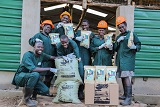
Mr Wolukawu
is currently processing vermicular in his village in Manafwa which he uses on
his maize farm and he says he has realised tremendous yield improvement.
A few other
individual farmers in the same area are also processing vermicular on small
which they are selling to fellow farmers. A bag containing 50kg is sold at Shs70,
000.
Properties
and advantages of the mineral
In a USA
based publication croplife about the use of vermicular in agriculture by
Claudia Ringler, it is stated that the mineral has a number of unique properties that make it a useful material in
agriculture.
It is particularly effective at
improving soil structure and drainage in sandy or loamy soils, which can be
prone to compaction and poor drainage.
Vermiculite can help to loosen
compacted soil and improve root growth by providing a porous, well-draining
environment for plants.
It is also effective at retaining moisture in soil,
making it a useful material for watering plants in dry conditions.
However, it is important to note that vermiculite
is a sterile material that does not contain any nutrients.
It is not a substitute for fertilizers and should
be used in conjunction with other soil amendments that provide nutrients to
plants.
In heavy clay soils, vermiculite
may be less effective at improving soil structure as it may not be able to
loosen the soil enough to make a significant difference.
In these cases, it may be more
effective to use other soil amendments, such as compost or fertilizer to
improve soil structure.
It is also reduces soil leaching
because it has high iron, potassium and magnesium content.
Soil amendment
Vermiculite can be mixed into soil
to improve its structure and water-holding capacity. It can help to loosen
compacted soil and improve root growth by providing a porous, well-draining
environment for plants.
Seed germination
Farmers often used it in seed
germination mixes to provide a sterile, nutrient rich environment for seedlings
to grow.
Rooting medium
Vermiculite can be used as a
rooting medium for cuttings and as a growing medium for hydroponics.
Mulch
It can be used as a mulch to regulate soil
temperature and moisture levels and to suppress weeds.
Potting mix component
Vermiculite can be
mixed into potting soil to improve its structure and water holding capacity
especially in nursery beds where potting is used to raise seedlings of plants
Vermiculite is pH neutral, making it suitable for use with a wide range
of plant species. Its non-toxicity makes it suitable for use in all types of
gardening and farming applications.
Experiment
The experts explained that between 2001 and 2004, selected farmers in
Mbale with the help of
Canmin Resource Ltd set up experimental farms where they applied the mineral in
their farms where they grew cabbages and tomatoes.
The result showed double yield. It was proved that once it is applied in
soil during planting it holds the soil well for small seeds of vegetables such
as tomatoes and cabbages
Disadvantages
Limited nutrient
content: Vermiculite
is a sterile material that does not contain any nutrients. It is not a
substitute for fertilizers and should be used in conjunction with other soil
amendments that provide nutrients to plants.
Poor structure in
heavy clay soils: Vermiculite can be less effective at improving soil structure in
heavy clay soils, as it may not be able to loosen the soil enough to make a
significant difference.
Limited
availability: Vermiculite is not as widely available as some other soil
amendments, such as compost or peat moss. It may be more difficult to find in
some areas.
Marketing
Apparently farmers such as Wolukawu are processing it and selling to
fellow farmers on small scale
However the companies mining the mineral are processing and packaging it
for export to countries such as Israel, USA and Canada.
The mineral exists in
countries such as South Africa, Mozambique and USA among others