Fish is an
important source of protein for millions of people throughout the world yet the
world’s natural occurrences are unable to meet the rapidly growing demands for
fish.
Breeding
fish using aquaculture may help to protect natural resources and ecosystems,
while improving for food security.
However this
is only possible if conducted within sustainable technology where
environmental, economic and social aspects must be taken into account equally.
As such
scientists at the Leibniz Institute of Freshwater Ecology and Inland Fisheries
(IGB) in Berlin Germany are conducting research in fresh water fish breeding
using aquaculture and aquaponics technology known as Tomato – Fish technology.
Already
Uganda’s scientists at the National Fisheries Resources Research Institute jointly
with their colleagues at the Aquaculture Research and Development center in
Kanajasi have conducted research using the above technology and deployed it to
farmers who are breeding Tialpia and African Cat fish across the country.
However
there are lessons Uganda’s scientists and farmers can learn from the Germany
experience.
Background
IGB is Germany's largest and one of the leading
international research centres for freshwater fisheries.
The scientists here
include hydrologists, biogeochemists, physicists, microbiologists, evolutionary
ecologists, fish ecologists and fisheries biologists conducting research with
their colleagues all over the world working under one roof.
The institute
collaborates with 70 research institutes across the world with a budget of 14.7
billion Euros in the area of aquarium, climate change, fresh water invasive species,
and aquatics leaving in cold water bodies as well as people rearing Amphibians
including cold water fish species.
Currently the fish ecologists and fisheries
biologists began a trail focusing on use of aquaculture and aquaponics
technology known as Tomato – Fish technology which is combined fish and
vegetable farming with the aim of saving usage of water, energy, artificial
fertilizer and space.
They are doing this with
an aim to reduce emissions in food production. The scientists are also using
their expertise in fish genetics and reproduction to protect the fish species
of interest.
The team communicates
their research outcomes to different stakeholders and practicing partners in a
targeted manner ensuring that the scientific findings are transferred to
practicing farmers and partners without delay.
As such the reporter
caught up with the scientists at the Institute and below are the details.
What scientists at the
Institute are doing?
Nadja Neumann the
communications officer of the Institute giving background of the IGB noted that
Institute is an arm of the Leibniz Association and it was found in 1995 located
in Berlin and Brandenburg.
It is an association
of 97 independent institutes organized in thematic sections with regular
exchange programmes in a disciplinary cooperation in research alliance and
networks on knowledge based evidence.
“Our core aim is to
research for future of our freshwaters with our scientists seeking to
understand fundamental processes that shape our fresh waters and their biotic
communities. We investigate how these systems respond to natural and
anthropogenic environmental changes,” she notes.
The institute
cooperation contains 11 joint professorship with 4 universities and they have
contractual agreements with 70 research institutes across the world and 390
employees.
Aquaculture and aquaponics
research
Global challenge of feeding
the world
Professor Werner
Kloas the head of department fish biology, fisheries and aquaculture explained
that by 2050, the world will need to feed 2 billion or more population and this
is possible using advanced technologies developed by scientists such as high
quality animal and fish protein.
However there is the challenge of shrinking resources which include,
space, water, nutrients, animal and fish protein, pollution, climate change,
over fishing, war, pandemics and negative impacts caused by unsustainable
farming practices.
He recommends that global demands require a change in concept of water,
energy and nutrient management footprints as well as reduction for water food
energy nexus.
This can be done by communities saving water use, its reuse, recycling
nutrient management, energy saving and alteration of energy use.
Aquaculture
technology
Prof Kloas defined aquaculture technology as rearing of aquatics organisms
such as fish, mussels (crocodiles) and plants under a confined controlled
condition including artificial reproduction, nourishing and protection against
diseases and their enemies.
To him if farmers adopt this technology which most of them have done
including those in Africa and Uganda, this will save the fresh water resources
because closed recirculation of the technology in indoor facilities will lead
to protection of the environment and no gas emissions into the environment.
Global fish
production
He contends that fish is globally the largest protein nutrition for
humanity with aquaculture the fastest booming sector of agriculture at a rate
of 3.8% per annum therefore any further fish production relying on this
technology will of advantage.
Apparently the statistics indicates that human nutrition from
aquaculture fish stands at 85 million tons per arum compared to capture fish at
73 milIion tons per annum.
This technology has its advantages because reduction in water foot
prints can be equated to 600 biomass relating to 1,500 litres water usage in
terms of fish breeding and figures differ for chicken, cattle and pigs. The
efficiency of water user is 5%-10% per day.
However the disadvantage is that it’s a high technology investment which
may not be affordable by ordinary small scale farmers.
Non sustainable
aquaculture; use of genetically modified organisms
Apparently scientists in USA have modified Frankenfish species which is
mix of salmon fish species and ocean pount (macrozoarces americananus).
However the scientists believe this may not sustain the world demand
therefore the intervention of aquaculture and aquaponics technology.
Aquaponics research
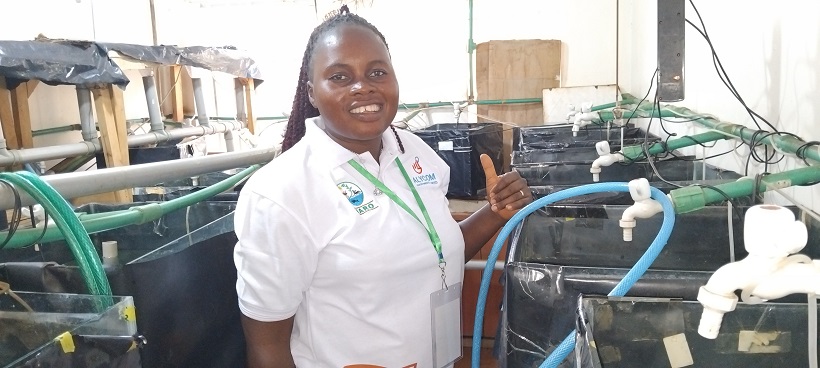
Prof Kloas and his team define aquaponics technology as the coupling of
fish aquaculture with plant production such as vegetables for saving resources.
The team has conducted research using this technology where various fish
species ranging from African Tilapia, African cat fish, Beacon fish species and
the genius Arapaima (pirarucu) native to the Amazon and Essequibo basins of
South America using the required
principal where the tomatoes are grown from the nutrient obtained from fish
breeding process.
The general principal in aquaponics farming is that farmers can breed
the fish species in drum containers with sediment system as filter mechanism.
This is after filling the containers with clean water and the fish are
fed using required nutritious feed as well as providing water fertilizer
nutrients for the fish to stay in fresh.
In countries such as China farmers practice this technology in paddy
rice fields where fish is bred in water in the rice fields and it has worked
well in a natural environment.
Scientists have to optimise the PH of the water because fish require
water PH 7 and for plants it has to be lower
However the experiment Prof Kloas conducted showed they were able to
harvest 300gms of tomatoes and each Tilapia for instance grew weighing 10kg
with use of 10 liters of water.
The fish feed of 32% protein are required tilapia but for salmon fish is
50-60%
The scientists discovered that fish species differ in protein meal
consumption and it is only fresh water fish species that can grow well and
survive without fish meal.
Comparison of fish
feed and water foot prints
For 1kg of fish biomass the protein content for Tilapias is 32% and the
fish feed is 1.5kg-2kg with carbon emission of 1.3 kg which is negligible.
The team concluded that farmers in Germany and other parts of Europe can
apply this technology by growing fresh water fish species while growing
tomatoes or any other vegetables.
As long as they follow the principle of filtering water and keeping it
clean to run into the area where tomato is growing, they will be able to
harvest twice, fish and vegetables.
Ugandan perspective
In Uganda
there has been an initiative where a team of scientists trained under a three
year project run by the Korea
International Cooperation Agency (Koica) through Chonbuk National University in
collaboration with Makerere University College of Agricultural and
Environmental Sciences (CAES) established a smart hydroponic technology at Makerere
University Agricultural Research Institute
Kabanyolo (MUARIK) farm with
sensors controlled panels.
The sensor internet
based technology is already being explored in Uganda at MUARIK farm by
scientists who went to study in South Korea and are implementing their
practical study experience.
They set up a smart
hydroponic farm which is internet control based and one of the important tools
which controls the entire greenhouse farm is the control panel.
Papius Tumusingiize
with expertise in Agricultural Convergence Technology explained that interacted
the function of the control panel in the growth process of Tomatoes in a
hydroponic greenhouse farm.
The
control panel contains electricity switches in an automatic mode and manual
form. It contains fuses which protects the entire panel system and other
sensors in the greenhouse.
The team
harvested tomatoes for continuous 9 months and the technology is now being
adopted by commercial farmers growing tomatoes on large scale.
Other
farmers are also breeding Tilapia in drums and using the filtered water as
manure to grow yams.
One such
a farmers is Mr Charles Mulamata’s family located in Budo Kisozi village about 7km
off Kampala Masaka road I who are engaged in fish breeding using Aquaponics
technology not necessarily for consumption but as a business initiative.