It is early on a Sunday morning and all roads are leading to the
National Crops Resources Research Institute (NaCRRI) for the World Food Day
celebrations.
Upon arrival at the Institute in Wakiso district,
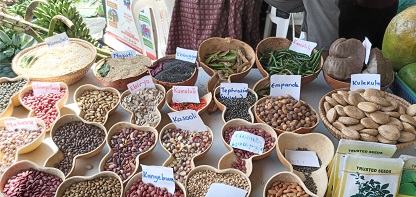
one is received by the colorful display of all food items processed form
various crop commodities that are bred by Agricultural Scientists from all the
research institute under their umbrella body the National Agricultural Research
Organization (Naro).
As the reporter is moving from one tent to another
scouting for information in a bid to write an article befitting the
celebrations of the day, some of the commodities include cassava rich in
vitamin A, rice with all yield and disease free attributes, orange fleshed
sweet potato, purple flesh Sweet Potato, Beans rich in Iron and Zink, Orange
fleshed Maize, vegetables of all varieties.
Others crops bred by scientists grown in Semi-Arid
areas namely simsim, sorghum, millet, green gram, sunflower, ground nut
varieties and banana, coffee varieties among others.
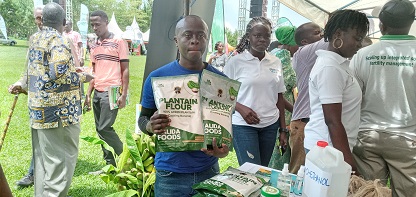
However the innovation by scientists at the
National Agricultural Research Laboratories (NaRL) where they are processing
East African Highland (Matoke) flour on large scale sparked a number of banana
farmers with many gathering in their tent seeking for knowledge.
Background
The East African Highland banana commonly known as (Matooke) is one of
the crops that is at in most parts of the country on both large and small
scale.
It is one of the important economic resources for rural farmers in
Uganda and the crop is grouped into types which include; nakabululu, muvubo M9
hybrid, kisubi, Nakitembe, Kiwangazi among others
Matooke is mainly grown in the western and central regions of the
country including in West Nile in Zombo district.
Yusufu Mukasa a food Chemist and head Food Processing Technology and
Incubation centre at NARL in Kawanda, explained the process of processing
banana into flour for nutrition and export purposes and below are the details.
Banana flour processing research
Mukasa notes that farmers in the country will now
smile because they will have ready market for their banana at his institute
since banana flour production has kicked off on large scale
This follows research that now turns green bananas
into flour which was initially done by Dr. Florence Muranga in conjunction with
scientists at Makerere University who carried out the banana research, which
spanned over a decade.
The research turned out to be that banana flour can
be processed, dried and consumed as nutrition food for pregnant mothers, babies
and persons with HIV/ Aids to improve on their immunity.
Scientists at NaRL carried out another research
where discovered persons with HIV/Aids in Rakai district could be helped by
processing nutritious banana flour and giving them to consume in porridge form
Statistical figures
Uganda is known as the Banana Republic of Africa that
produces Ten million tons of bananas annually.
It is one of the leading income and revenue earning product for the
Country and to the farmers growing the crop. In a publication by scientists
from NaRL, it is stated that total of 173 people living with HIV/Aids were
registered with Rakai Health Scince Project.
They were interviewed using structured questionnaire to determine the
current contribution of banana to the household food security.
Nutrient intake were collected and food frequency questionnaire and
experiments were conducted to determine the suitability of banana as food to
boost the energy and nutrient intake.
The formulation reached using the persons square method with target
protein content of 15%. The pilot test product , the nutrient enhanced
banana powder was distributed to the participants. the supplement diet
showed that the participants health were boosted since the product
contained Iron and Zinc
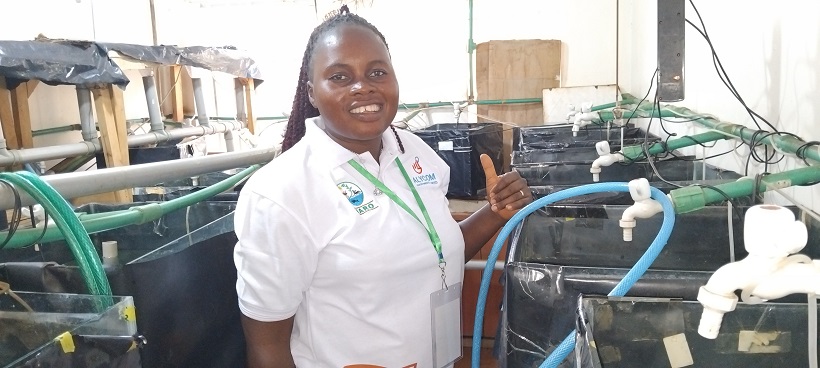
Banana flour processing at NaRL
Mukasa noted that as food scientists his team came up with sample
extracts which were tested at the Laboratory to ensure the mixture is good for
human consumption.
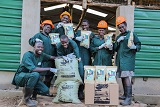
The scientists teamed up with private food processing company namely
Kalida Foods who service of the technical equipment and quality support at the
food processing in NaRL to produce banana flour on large quantity.
The team is supplying and selling the products to patients in hospitals,
rural communities where malnutrition level is high. They are also exporting it
to USA, Nigeria and Norway, This initiative started in 2021.
The team purchases banana clusters from farmers in Mbarara, Busehenyi,
Kyejojo, Masaka, Bushenyi and Insingiro among others.
Once the clusters are delivered at NaRL,, a group of women and youth
have been employed to peel the banana and this is after the clusters are washed
clean with water.
The peeled banana is then washed in food in food grade solution called
Meta Bisulphite to maintain its colour.
It is the sliced with automated slicing machine and the thickness must
be 5ml to maintain good drying
Once this is done it is the taken to grinding mill to get banana flour
ready for packaging. These Slices are put on trays which have holes to enable
water to drip and they are loaded in the drier which heats at 60 degrees
Celsius.
It has dry in 24 hours to ensure the nutrient is maintained . The
required moisture content is 12% and it is left to cool before it is taken for
milling to get fine flour. The team is able to mill 1 ton of banana flour per
day and these are packaged in 2kg. It sold Shs10,000 in the local markets and
supermarkets but the export price Shs50,000 .
Qualities
The flour is gluten free, it contains some percentage of starch,
protein, fibre and potassium good for human consumption.
The scientists recommend it for bakery industries who are making
confectionaries such as bread, cakes, biscuits and waffles among others
including baby foods for making porridge. It can be mixed with millet flour,
soybean flour, maize flour among others.
The product apparently is being sold in Super Markets in Kampala
and surrounding districts.
|
The Scientists have also gone ahead to develop standards for banana
products, the first of its kind which they have submitted Uganda National
Bureau of Standards (UNBS) for perusal. They are also in process of obtained certification from UNBS to allow
legal procedures of marketing the product including patenting both within the
country and export. |