Agricultural
scientists engage vegetable farmers in rolling out seed breeding process
A number of farmers across the country over the years have
taken up growing of various vegetable varieties of both indigenous and exotic
as source of nutritional diet.
One such farmer group is the Namulonge Horticulture,
vegetables and fruits farmers’ association located in Wakiso district where
members are engaged in growing vegetables namely, Nakatti, Amaranth (Dodo),
broccoli, cabbages, berry tomatoes and butternut among others.
They have been doing this as income earning initiative
including growing exotic Chinese vegetables varieties for purposes of tapping into
the market for Asian communities living in the country.
However they team is faced with the challenge of purchasing
seed for the vegetables which are imported mainly from Netherlands with each
tin costing between Shs85, 000- Shs100, 000 or more depending on the vegetable
variety.
Background
According to agricultural experts at the National
Agricultural Research Organisation (Naro), it is a concerted effort to conserve
already existing vegetable germplasm collected over the years to enable
increased vegetable production in the country in order to meet the growing
demand.
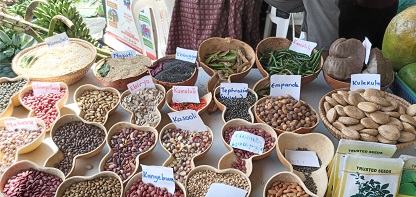
The most important traditional vegetables in Uganda are Amaranthus spp., common
beans (Phaseolus vulgaris), butter
beans (Phaseolus lunatus), Cow pea (Vigna unguiculata),
Simsim (Sesamum indicum), Cassava (Manihot esculenta), Jute
Mallow (Corchorus spp.) acorn squash, Cucurbita spp, Eggplant (Solarium aethiopicum Amaarnth, Aleui,
Malakwanga and cow pea leaves mainly consumed in eastern and Northern Ugandan.
Apart from conserving germplasm, scientists
think seed production is key to bail out farmers from the current high costs.
As such agricultural
scientists at the National Crops Resources Research Institute (NaCRRI) have
teamed up with Korea International Cooperation
Agency (KOICA) to breed five major vegetables for seed
processing within Uganda.
The vegetables being bred are Pepper, Onions, cabbages,
Tomatoes and Nakatti all using locally processed seed within the Country.
This is under 8 year project which was officially launched at
NaCRRI Institute last week attracting a number of stake holders dealing in the
vegetable value chain including vegetables farmers, seed companies ,
scientists, farmers and below are the details.
Vegetable seed development project process
The Director NaCRRI Dr Geoffrey Asea giving over view of the
project welcomed all the delegation including the ambassador of the Republic of
South Korea
He noted that since vegetables are consumed to address
special nutritional need, it is important for the institute to prioritize in
its research for quality seed processing.
The project implementation process according to Dr Asea began
by the scientists going to the farming communities across the country to assess
the needs of the consuming communities thereby zeroing on five vegetable
commodities with commercial potential.
It is a Project being funded by the Republic of South Korea
through KOICA worthy 8million US dollars.
He contends that by launching the project officially, it
marks the breeding process of the five vegetable varieties where initial seed
production will kick off early 2023.
Dr Myoung Rae Cho the Koica VegeSeed project
manager noted that once the seed production kicks off, the multiplication
process will be managed by Naro Holdings Ltd the commercial arm of Naro,
jointly with seed companies for onward distribution to farmers.
The key sites for breeding and testing are in
Luwero and Mukono and this is after laboratory seed tests have been evaluated
in see Laboratories in South Korea.
The Director Naro, Dr Ambrose Agona noted that
“Uganda is gifted by nature the reason you see farmers and seed companies
exhibiting a number of vegetable varieties which they are already growing to
fulfil consumer needs. However this does not stop Naro scientists to
collaborate with scientists in the Republic of South Korea to develop the seed
for farmer uptake,”
Dr Agona noted that what is key is that the
project address the gap of knowledge sharing about processing of vegetable seed
between Scientists at Naro and those in the Republic of South Korea
He cautioned public opinion where they think
outputs produced as a result of research are hazardous to the environment.
“A number of food consumed by Uganda’s
population is as result of research work done by Naro scientists be it cassava,
maize, rice, beans including vegetables. When developing products for food
consumption, the scientists are cautious therefore what we first consider is to
make sure biodiversity is not contaminated,” Dr Agona noted.
The Minister of Agriculture Fred Bwino
Kyakulaga noted that vegetable seed production is a crucial area his ministry
is looking into because of the importance of vegetables in addressing
nutritional food needs.
This is because seed availability, access and
affordability by small scale farmers is crucial and this research initiative
has come timely to bridge the gap.
It is his contention that such joint
collaborations will help address the farmers need because it is through
research that products can be availed to the farmers at reduced costs.
In most cases the breeding process to obtain
seed may be long because it can take six years or more the reason the project
duration is 8 years to enable the process to be complete.
Secondly what is bred must adopt to various
climatic conditions in the different agro ecological zones.
This means farmers in central, Eastern,
Northern and Western Uganda will have the opportunity to grow the five
vegetables of concern.
Statistical
figures
The Programme leader for vegetable breeding at NaCRRI Dr
Gabriel Ddamulira taking the guests through the exhibition gave the statistical
figures saying vegetable production rate in the country currently stands at 5.3
million tons contributing 34million dollars annually with the growth rate
standing 3.86%.
He notes that it is the reason for farmers to take up this
opportunity because horticulture represents profitable opportunities for them.
He however notes that the initiative comes in handy to
address challenges already faced by farmers growing vegetables namely poor seed
systems, lack of cold chains for storing seed, poor post-harvest handling and
the need for research to address climate change conditions among others.
Farmers speak out
Ms Sylvia Naigaga a member of Namulonge
Horticulture farmers’ Association appreciates the initiative saying it has come
in handy because already farmers are faced with the high costs of vegetable
seed.
She notes that all farmers need is good
quality seed whose output is portrayed in higher yields, therefore since the
seed production is geared towards quality seed production, it bail out the
farmers
“What I am appealing for is that farmers must be
brought on board in all the stages because we need the technical information to
guide us including the good agronomy practices. This is because a farmer will
always be happy to obtain higher yields for increased income,”
To her since the farmers in her association in
close to Kampala, there is always readily available market for both indigenous
and exotic Chinese vegetable varieties.