Scientists encourage Rabbit Farmers
across the country to breed in organised way
Over the years the overall focus of
agricultural scientists at the National
Animal Genetic Resources Centre (NAGRIC) & Data Bank has been an increasing utilization of improved germplasm.
This is in a bid to sustain efforts in that direction
so that farmers can access superior breeds of animals as income earning
initiative including Rabbits.
Background
Rabbits reproduce and grow fast, making them one of the best
choices for the fur trade and meat production.
There is massive
advantage of rabbit rearing because a farmer can even start with 10 rabbits as
starter which can be kept in 2 cages.
Other advantages
according to the experts is that a farmer can sell its urine or use it as
fertilizer mixer.
The demand for its
meat is growing and is served in several hotels and restaurants.
Experts say it takes
rabbits 70 days from birth to reach market weight and it doesn’t need a lot of
land to rear them.
As such Seeds of Gold
interacted with scientists from NAGRIC and DB about the need for rabbit farmers
across the country to get organised and embark on rearing them as commercial
initiative. Below are the details.
Rabbit breeding process
Arthur Emmanuel
Tumwine the in charge of rabbit breeding at NAGRIC and DB explaining the
breeding process notes that his team is now organizing farmers in Western and
Central Uganda as a starting point on how to breed rabbits.
Once this model
succeeds, it will be expanded to the rest of regions in Eastern and Northern Uganda
where rabbit breeding is picking up.
The team has built
capacity for farmers to become breeders and each group ranges between 30- 50
members depending on how they organise themselves into various groups.
The farmers belong to
members of the Uganda Cuniculture Association which was formed in 2020 and the
membership is open to all farmers already rearing rabbits who are expected to
pay Shs50, 000 membership fee as well as subscription whose rate will be
determined by the farmers themselves.
The scientists are in
the process of acquiring breeder stock where each group will be given 50 female
rabbits and 10 males.
Once they multiply, then each farmer will be expected to ensure 1 male rabbit is rationed to 10 females with each female in its cage and once the male has met it, then it should be taken away because rabbits produce at a rapid speed.
When the farmer
multiplier rations the female and male rabbits, they are expected to produce 6
off springs.
“Once the rabbit
cross breeds which will be imported from rabbit breeding countries, They will
be supplied to NAGRIC and DB, these will be given to the farmer groups and
eventually to breeder multipliers who will be expected to multipliy300 rabbits
from the 50 parent stock,”
Rabbit breeds
There are both local,
cross and hybrids but the scientists are concentrating mainly on hybrids which
are good for meat quality and fur.
Polish rabbit breeds
These breeds include
Polish rabbit breeds which once grown can weigh 4-5 kg and is good for meat
production.
White New Zealand
The white New Zealand
rabbit breed is popular and highly productive commercial breed. It has a great
demand around the world. Once grown it can weigh 9-12kg and it is good for fur
production
Californian
Californian
rabbit breed is another highly productive and widely famous commercial rabbit.
This breed is also an American creation arising from crossbreeds which was done
way back in 1923.
Californian
rabbit breed is very popular for their meat production. Their body is white
colored. Nose, ears, tail and feet are dark grey or black coloured.
When the bucks
gain maturity they weights 3.5 and the does 4.5kg depending on how a farmer
feeds them.
American Chinchila
Chinchilla rabbits
are generally quite docile, good
natured and very gentle. They are intelligent, curious and playful
rabbits and enjoy company and attention.
They are usually good
to their young ones and are also well-suited as house rabbits. They weigh
between 4.5kg and 5kg ad are good for meat and fur.
The local breeds
Usually farmers name
them according the regions were they are being bred. Those from Western are
named Ankole breeds but the scientists are discouraging farmers from rearing
the local breeds unless for home consumption because they do not produce much
meat and fur for commercialisation.
Diseases and epidemiology
diagnostics
There are number of
diseases that may affect rabbits including bacterial infections and Tumwine and
his team have sensitized the farmers how to go about handling such diseases.
Farmers are expected
to take blood samples which is taken to the Epidemiology centre in Entebbe for
diagnostic analysis and possible treatment
These diseases
include Listeria which is a bacterial infection which lead to lead swellings on
the head. It usually arises from contamination of food or water given to the
rabbit and thus can be treated by a recommended antibiotics
Others are Pasteurellosis which is common in domestic
rabbits. It occurs tthrough direct contact with nasal secretions,
including transmission through the air when the infected rabbit sneezes.
It can be treated using recommended antibiotics.
It is also important for farmers to avoid unhygienic
practices that may lead to pests such as rodents from attacking rabbits in the
cages.
The recommended rearing practices
Tumwine
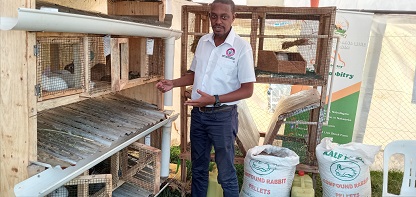
explained that it is important for the farmer to start with good construction
units where the cages must be raised with a provision to collect the droppings
and piping to enable urine collection.
One box
unit will cost between Shs30, 000 and 50,000 depending on the material used
It is
important to purchase breeding stock from a recommended source where there is
no inbreeding
Usually the
females reach their puberty at five months and if not separated from the male,
it may conceive there and then even its young one are two to three days old. It
is important to ensure the female ones conceive after one month.
Feed them
with clean water which can be punched in bottles and add mineral leaks to the
water to provide good minerals for their body.
They can be
fed with grass such as Rhodes grass (Chloris gayana), bracharia grass, pellets made from
soybean mixture with silver fish.
Usually a
pair of breeder stock can cost between Shs50, 000 to Shs150, 000 depending on
the region where it is sold from.
Farmers are
encouraged to collect rabbit urine as income earning initiative as fertilizer
mixture. 5 litre jerrican costs shs20, 000 but may vary depending on the area
where it is sold.
Health benefits and
marketing
Rabbits
have a light impact on the earth, and they are healthy with white meat, rich in highly-quality proteins,
omega-3 fatty acids, vitamin B12 and minerals like calcium and potassium
The meat is also lean and low
in cholesterol it is not fatty meaning one needs to take caution when preparing
it.
Most farmers sell the meat in
common supper markets between sh28, 000 - shs35, 000,
so to satisfy the Ugandan market, a ton of rabbit meat should be produced each
day
The production on average are 1, 000 rabbits if the whole common weight
is considered or about 500 if improved breeds are used